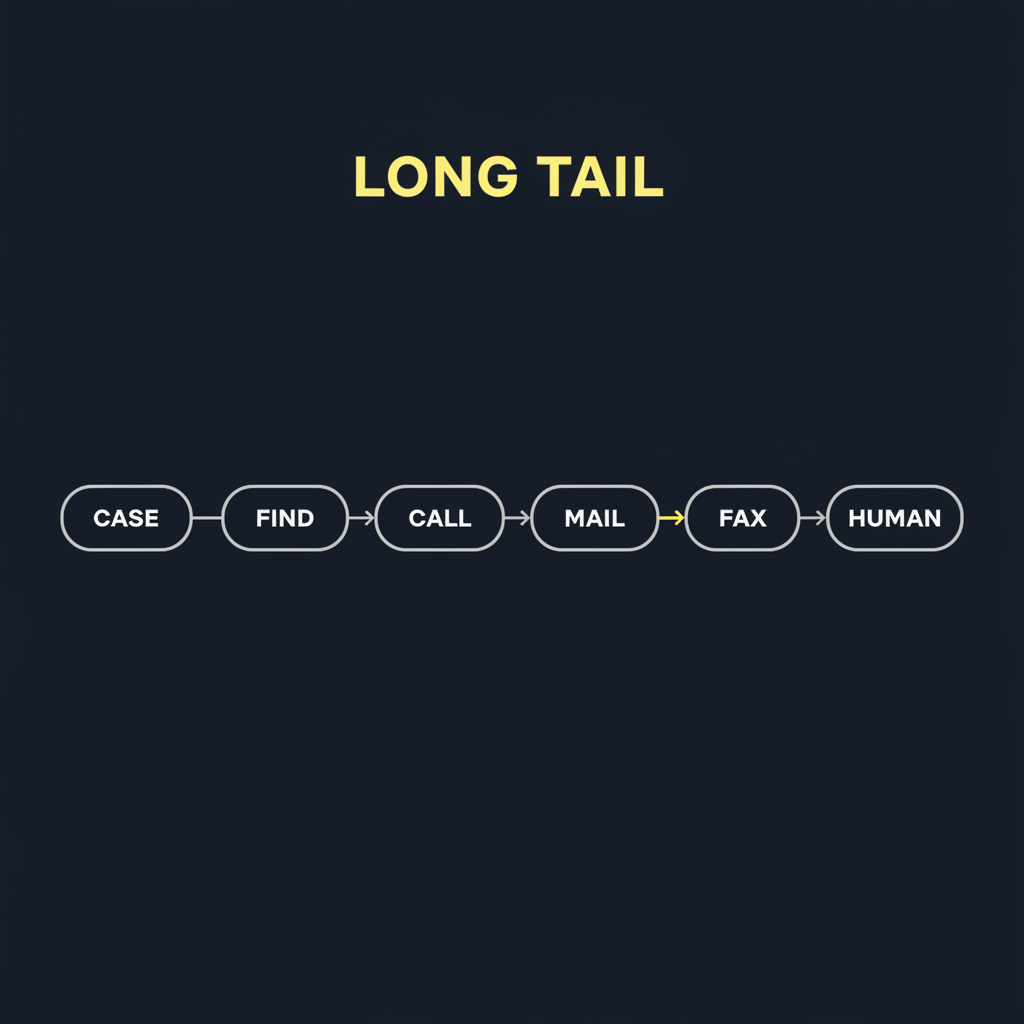
Payroll databases are a CRA's best friend — until they aren't. In 2026, the leading employment data repositories collectively cover an estimated 60% of the U.S. workforce. That number sounds solid until you do the math on what's left. The Bureau of Labor Statistics counts roughly 163 million people in the civilian labor force. The other 40% — somewhere north of 65 million workers — aren't in any database you can query. They work for the small plumbing company, the regional hotel chain, the seasonal farm labor contractor, the gig platform that doesn't report payroll data. They're recent hires whose records haven't propagated yet. They're employees of businesses that opted out.
This is the long tail of employment verification. And for CRAs, it's where unit economics go to die.
Every case that falls outside database coverage requires direct employer outreach. That means phone calls, emails, faxes, follow-ups, and more follow-ups. It means callers sitting on hold. It means cases aging past your SLA while a regional HR manager returns from vacation. The cost-per-case on long-tail verifications can run three to five times higher than a clean database hit, and turnaround time blows out in ways that create real FCRA exposure.
The fix isn't more callers. It's a structured, multi-channel outreach process with clear fallback logic — and increasingly, that process is being automated by AI. This playbook walks through how CRAs can systematically handle the long tail without letting it erode margins or TAT commitments. For a broader look at the vendor landscape, see our 2026 ranking of CRA-focused verification vendors.
Why the Long Tail Breaks CRA Margins
The economics are straightforward. A database verification costs a few dollars and returns a result in seconds. A manual outreach case — where a caller has to find the right number, reach a human, confirm identity, collect data, and document the interaction — can take 30 to 90 minutes of labor spread across multiple attempts, plus queue time between attempts.
At scale, that gap is brutal. A CRA processing 500 cases per day with a 40% long-tail rate is handling 200 manual outreach cases daily. If each one averages 45 minutes of labor (including hold time, callbacks, and documentation), that's 150 hours of staff time per day on cases that databases couldn't resolve. At a fully-loaded cost of $25/hour for a verification specialist, that's $3,750 per day — $975,000 per year — on the long tail alone.
Turnaround time compounds the problem. Database hits are instant. Manual outreach cases depend on when an HR contact picks up the phone, reads an email, or processes a fax. A single unresponsive employer can hold a case open for three to five business days. For CRAs with 3-day TAT commitments to their clients, that's a breach. For mortgage lenders with closing-window deadlines, it's a deal-killer.
The FCRA dimension adds another layer. Under the Act, CRAs must follow reasonable procedures to ensure maximum possible accuracy. When an employer is unresponsive, the documentation trail — what was attempted, when, through which channels, and what response (or non-response) was received — becomes the legal record. Incomplete documentation isn't just sloppy. It's a compliance liability.

Who Lives in the Long Tail
Understanding which employer types drive long-tail volume helps CRAs prioritize their outreach infrastructure.
Small businesses under 50 employees. The U.S. Small Business Administration reports that businesses with fewer than 50 employees account for roughly 30% of private-sector employment. Most of them don't have a dedicated HR department. Verification requests land in the owner's inbox, the office manager's voicemail, or nowhere at all. These employers are rarely in payroll databases, and they respond inconsistently to outreach.
Gig economy and platform employers. Workers who earned income through delivery platforms, rideshare companies, staffing agencies, or 1099 arrangements present a particular challenge. The employer of record may be a platform that doesn't respond to traditional VOE requests, or there may be no employer of record at all. Databases like The Work Number and Truework cover strong payroll-connected employment — they weren't built for gig income documentation.
Recent hires (under 90 days). Payroll data takes time to flow into verification databases. A candidate who started a job two months ago may not appear in any repository yet. The employer exists, the employment is real, but the only way to verify it is direct outreach.
Regional and seasonal employers. Agricultural operations, construction contractors, hospitality groups, and similar businesses often have small, rotating HR functions. They may not participate in national payroll networks. Their contact information changes. They may be unreachable during off-season periods.
Employers who have opted out or blocked access. Some companies — typically for privacy or competitive reasons — have explicitly opted out of database participation or blocked third-party data sharing. No database query will ever return a result for these employers. Direct outreach is the only path.
The 5-Step CRA Playbook for Unresponsive Employer Outreach
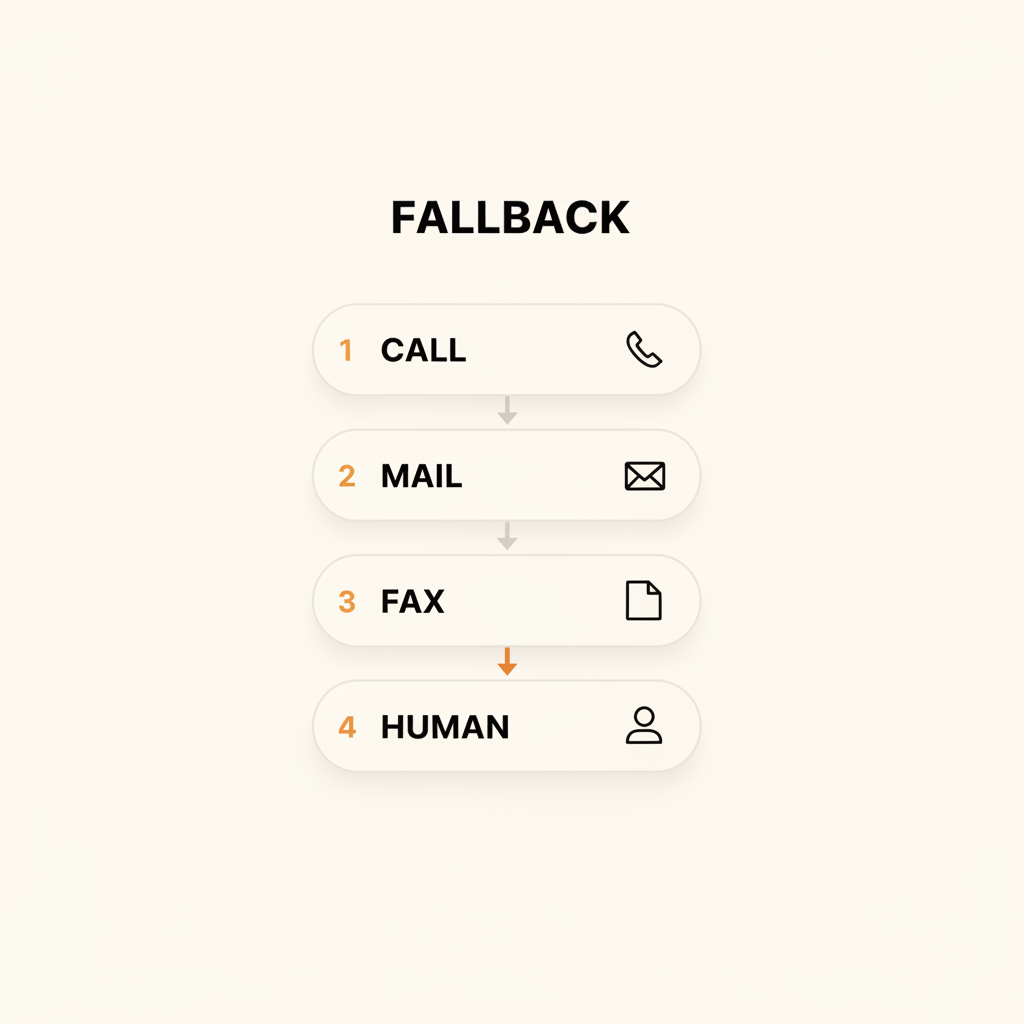
The key insight is that each channel in the outreach sequence serves a different purpose, and each one only fires when the prior one has failed. This isn't "try everything at once." It's a structured fallback chain with clear trigger conditions, documented at every step.
Step 1 — Contact Research and Phone-Number Discovery
Before any outreach attempt, you need verified contact data. The employer's name and general address from the candidate's application are not enough. You need a direct HR line, a verified fax number, or a named contact.
This step involves querying business registries, LinkedIn, company websites, and commercial contact databases. For a CRA processing hundreds of cases per day, manual contact research is itself a bottleneck. AI-assisted contact research — querying across multiple business data sources simultaneously — can resolve a verified HR contact in seconds rather than minutes. Superunit's employment and income verification product, for example, queries across approximately 100 million business records globally to surface direct HR contacts before any outreach attempt begins.
The output of this step is a verified contact record: phone number, email address, and fax number where available. Cases without any resolvable contact go to a manual research queue. Cases with contact data proceed to Step 2.
Step 2 — AI Voice Outreach with Structured Retry Logic
The first outreach channel is phone. AI voice agents can call an HR line, navigate IVR systems, identify the right department, deliver a structured verification request, and collect a verbal confirmation — all without a human caller. When no one answers, the system logs the attempt with a timestamp and schedules a retry.
Retry logic matters. A single call attempt is not a good-faith effort under FCRA standards. A well-configured system makes at least three attempts across different times of day (morning, midday, late afternoon) before declaring the phone channel exhausted. Each attempt is logged with the timestamp, the number dialed, the outcome (no answer, voicemail, busy, connected), and any response received.
One important note: AI voice outreach works best when the verification request is structured and the expected response is bounded. Confirming dates of employment, job title, and eligibility for rehire is well within what current voice AI handles reliably. Open-ended conversations about complex employment histories are not.
Step 3 — AI Email Fallback with Adaptive Subject Lines
When phone attempts fail, the system pivots to email. AI-generated outreach emails have one job: get opened and get a response. Subject line construction matters more than most CRAs realize. "Employment Verification Request" gets filtered or ignored. A subject line that includes the candidate's name, the requesting organization, and a specific deadline ("Action Required: VOE for [Name] — Response Needed by [Date]") performs significantly better.
Adaptive subject lines — where the system tests variations and routes future sends based on open-rate signals — can improve response rates meaningfully over static templates. The email body should be short, direct, and include a clear response mechanism: a reply-to address, a secure response portal link, or a callback number.
Two to three email attempts over 48 hours, with timestamps and delivery receipts logged, constitute a documented email outreach sequence. If no response is received, the case proceeds to Step 4.
Step 4 — AI Fax for Mortgage and CRA Holdouts
Fax is not dead. It is, in fact, the preferred channel for a meaningful subset of HR departments — particularly at hospitals, government contractors, financial institutions, and regional businesses that have standardized on fax for compliance reasons. In mortgage workflows especially, fax remains a common VOE response channel.
AI fax outreach sends a structured verification request form to the employer's fax number. The form includes the candidate's name, employment dates to verify, the CRA's contact information, and a clear return-fax or response deadline. Fax attempts are logged with transmission confirmations.
CRAs that skip fax outreach are leaving a viable channel unused and creating documentation gaps. A complete outreach record shows phone, email, and fax attempts — not just the two channels the CRA found convenient. For a deeper look at building a complete manual employment verification for background screening process, that guide covers documentation standards in detail.
Step 5 — Human Escalation as the Last 5%, Not the First 50%
When all three automated channels have been exhausted without a response, the case escalates to a human specialist. At this point, the specialist has a complete contact record, a full log of prior attempts, and a documented timeline. They're not starting from scratch — they're making a final, informed attempt with full context.
Human escalation should represent a small fraction of total volume. If it's representing 30%, 40%, or 50% of your cases, the automated channels aren't configured correctly, or your contact research is failing before outreach begins. The goal is to reserve human time for the genuinely hard cases: employers who are hostile, situations requiring judgment, or cases where the automated record needs to be supplemented with a direct conversation.
This is the model Superunit is built around: AI handles the outreach sequence, humans handle the exceptions. For more on how to structure the calling HR departments for employment verifications workflow when human outreach is required, that guide covers the specific scripts and documentation practices.
What Good Documentation Looks Like: FCRA Chain of Custody for Unresponsive Cases
Under the FCRA, a CRA's obligation doesn't end when an employer fails to respond. The obligation is to document the attempt — thoroughly enough to demonstrate that reasonable procedures were followed.
A compliant unresponsive-employer case file should contain:
Contact attempt log. Every outreach attempt, timestamped, with the channel used (phone, email, fax), the contact information used, and the outcome. "No answer" is a valid outcome — but it needs a timestamp and a record of which number was called.
Contact research documentation. Where did the contact information come from? If you called a number sourced from a commercial database, note the source. If you found an HR email on the company's website, note that. This establishes that you used a reasonable method to find the right contact, not just whatever was on the application.
Response records. If the employer did eventually respond — even partially — document exactly what was said or written, by whom, and when. A verbal confirmation over the phone should be transcribed. An email response should be retained in the case file.
Escalation notes. When the case moved from automated to human handling, who took it, what additional steps were taken, and what the final determination was.
Final disposition. If the employer never responded and the case was closed as unverifiable, that determination and the basis for it need to be documented. The FCRA doesn't require that every verification succeed — it requires that the process be reasonable and documented.
AI-driven outreach systems produce this documentation automatically: every call is recorded and transcribed, every email is logged with delivery and open status, every fax carries a transmission confirmation. The audit trail is a byproduct of the process, not a separate administrative task. That's a significant operational advantage over manual processes, where documentation quality depends on individual caller discipline. For a detailed walkthrough of Superunit's AI-powered audit trail approach, that piece covers the chain-of-custody mechanics specifically.

Outsource vs. Build In-House: A Decision Framework
CRAs face a genuine build-vs-buy decision when it comes to long-tail outreach infrastructure. Neither answer is universally correct.
When in-house makes sense:
- Your long-tail volume is low and predictable (under 50 cases/day)
- You have existing caller staff with capacity to absorb the work
- Your client contracts require you to own the outreach process
- You have the technical resources to build and maintain an AI outreach system
When outsourcing wins:
- Long-tail volume is high, variable, or growing faster than you can staff
- Your cost-per-case on manual outreach is above $15–20 and climbing
- You're missing TAT SLAs on unresponsive-employer cases
- You need the FCRA documentation trail to be automated and auditable, not dependent on individual caller discipline
- You want to scale volume without scaling headcount
For a detailed look at the cost math and staffing tradeoffs, see how to outsource employment verification and reduce staffing costs.
Questions to ask any outreach vendor:
- What channels do you support, and what does the fallback sequence look like?
- How is contact research performed, and what's your hit rate on small employers?
- What does the documentation output look like — is it FCRA-ready out of the box?
- How do you handle escalation to human review, and what's your escalation rate?
- What's your pricing model — per attempt, per completed verification, or per case?
- Do you have existing integrations with background screening platforms?
For a broader comparison of how different vendors approach this problem, see our 2026 ranking of CRA-focused verification vendors, which covers the major players and their long-tail handling capabilities.
Frequently Asked Questions
What percentage of employment verifications require direct employer outreach?
Industry estimates vary, but CRAs consistently report that 35–45% of verification requests cannot be resolved through payroll databases alone. The exact figure depends on your client mix — CRAs serving industries with high concentrations of small employers or gig workers will see higher rates. The 40% figure used in this article reflects commonly cited estimates for general-population CRA workflows; your actual rate may differ.
How many contact attempts are required under the FCRA before a case can be closed as unverifiable?
The FCRA does not specify a minimum number of attempts. The standard is "reasonable procedures" — which regulators and courts have interpreted to mean multiple attempts across a reasonable time period using appropriate channels. Three to five attempts over five to seven business days, across phone, email, and fax where applicable, is a defensible standard. Document every attempt regardless of outcome.
Can AI voice agents handle employment verification calls legally?
Yes, with appropriate disclosures. AI voice agents used for employment verification outreach are generally subject to the same rules as human callers under the FCRA and applicable state laws. The call must identify the purpose of the contact, the requesting organization, and provide a way for the employer to follow up. Some states have additional disclosure requirements for automated calls. Consult your compliance counsel on state-specific requirements before deploying AI voice outreach.
What's the difference between a database-based verification and a direct employer verification?
Database verifications query a repository (such as The Work Number by Equifax, Truework, or Argyle) that has pre-collected employment data from payroll systems. They're fast and low-cost but only cover employers who participate in those networks. Direct employer verifications contact the employer directly — by phone, email, or fax — to confirm employment details. Direct verifications are slower and more expensive but cover employers outside the database networks and are the only option for the long tail. For a complete comparison of these approaches, see our complete guide to employment verification for CRAs.
How do I know which department to contact for an employment verification?
For most mid-size and large employers, employment verifications are handled by HR or a dedicated employment verification team. Some large employers outsource this function entirely to a third-party verification service. For small businesses, the owner or office manager is often the right contact. When in doubt, a general company phone number with a request to be transferred to "whoever handles employment verifications" is a reasonable starting point. Our guide on which department to call for employment verification and what to do covers this in more detail, including scripts for navigating IVR systems and gatekeepers.
The long tail isn't going away. As the gig economy grows and small-employer hiring continues to outpace large-employer hiring, the 40% of the workforce outside payroll databases will likely stay at 40% or grow. CRAs that build a structured, documented, multi-channel outreach process for these cases — and automate as much of it as possible — will protect their margins, hit their TAT commitments, and produce the kind of audit trail that keeps compliance teams comfortable. Those that keep throwing more callers at the problem will keep watching cost-per-case climb.
Superunit's background screening solution is built specifically for this workflow. For a deeper look at how to evaluate the vendors that can help build this process, start with our 2026 ranking of CRA-focused verification vendors.