When a regulator or auditor pulls a verification file, they are not checking whether employment was confirmed. They are checking whether you can prove how it was confirmed, by whom, and when. The gap between completing a verification and documenting one is where compliance failures live.
Manual verification processes produce answers. They rarely produce defensible records. For CRAs subject to FCRA scrutiny, mortgage lenders operating under Fannie Mae and Freddie Mac guidelines, and DOT background screeners maintaining driver qualification files, that distinction carries financial and legal consequences.
What Is a Verification Audit Trail?
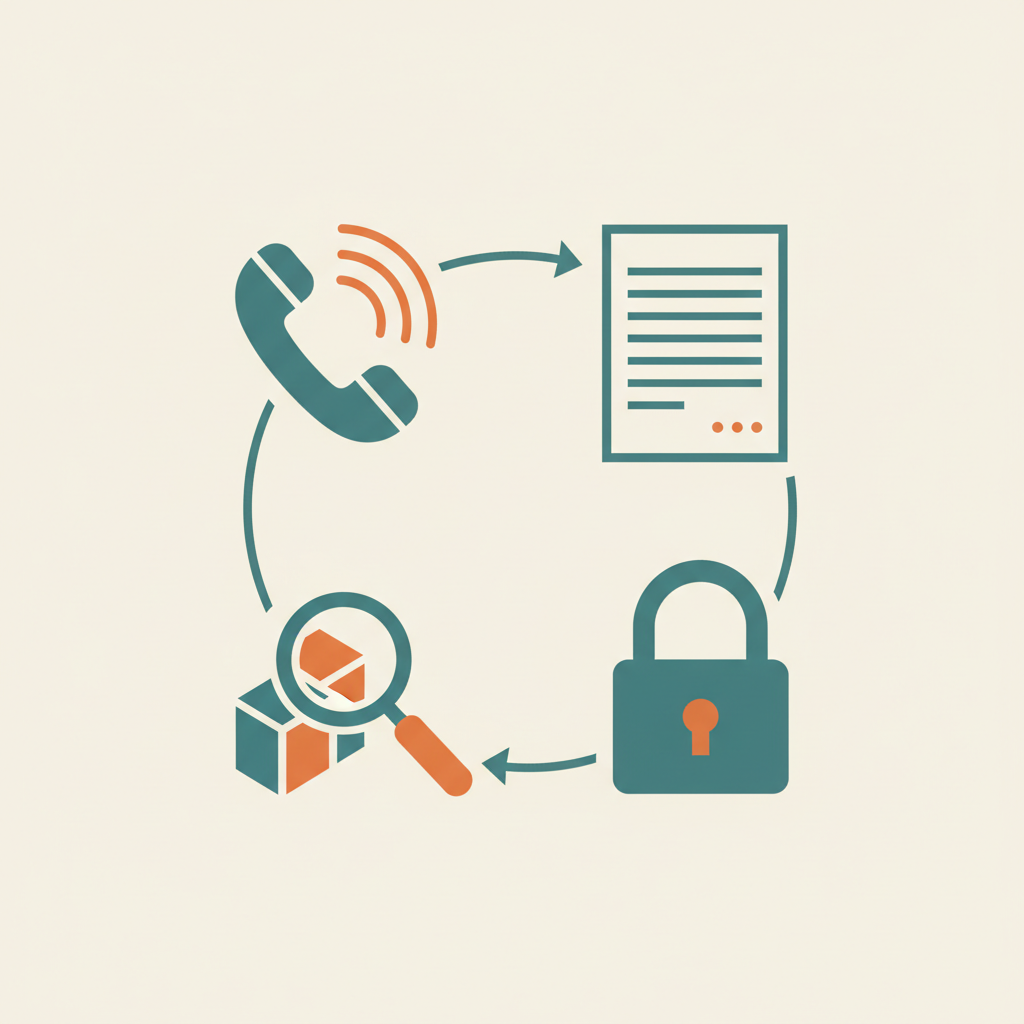
A verification audit trail is the complete, documented record of every step taken to confirm a candidate's or borrower's employment. It consists of four components: call recordings, transcripts, timestamps, and chain of custody documentation. Together, these components answer the questions an auditor will ask: what was confirmed, who confirmed it, when was contact made, and how was the information captured.
Call Recordings and Transcripts
Most employment verifications involve a phone call to an employer's HR department. If that call is not recorded, the only evidence of what was said is the verifier's handwritten or typed notes. In a dispute or audit, those notes carry little weight because they cannot be independently verified.
A transcript generated from a recorded call provides a verbatim account of the exchange. It captures the specific language used by the employer representative, the questions asked, and the answers given. Verbal confirmations without recordings are, in practical terms, unverifiable.
Timestamps and Chain of Custody
Timestamps establish when each event in the verification process occurred: when the request was received, when the employer was first contacted, when a response was obtained, and when the verification was finalized. Regulators across industries require this chronological documentation because it proves diligence and timeliness.
Chain of custody refers to the documented handoff of information at each stage. It answers the question of how data moved from the employer's confirmation to the final report. Without it, there is no way to demonstrate that the information in the report matches what was originally provided.

Why Regulators Require a Complete Audit Trail
FCRA Requirements for CRAs
Under FCRA (15 U.S.C. § 1681e), consumer reporting agencies must "follow reasonable procedures to assure maximum possible accuracy" of the information in consumer reports. The word "procedures" is doing heavy lifting in that statute. A CRA that cannot show documented, repeatable processes for verifying employment data has a weak defense in any accuracy dispute.
FCRA compliance best practices include preserving timestamps for all disclosures and authorizations, along with maintaining clear records of every step in the screening process. "Reasonable procedures" is a standard that auditors and courts evaluate based on documentation, not intentions.
FMCSA Requirements for DOT Verifications
49 CFR Part 391 requires motor carriers to investigate, document, and retain every driver's three-year employment history in the driver qualification file. Completed verifications and communication logs must be retained for a minimum of one year. MVR records require three-year retention.
The documentation burden is significant. As of January 2020, employers must conduct both electronic queries in the FMCSA Clearinghouse and traditional manual inquiries with previous employers. "Every year, carriers face audits that uncover missing driver records. Even one lapse can cost tens of thousands in fines."
Mortgage VOE Requirements (Fannie Mae and Freddie Mac)
Mortgage lenders face prescriptive documentation standards. Freddie Mac Guide Section 5302.2 requires the mortgage file to include Form 90 (Verbal Verification of Employment) or a similar written document capturing the borrower's name, employer details, and employment status. Section 5302.3 mandates that a copy of the verification be retained in the mortgage file.
Timeliness requirements add another layer. Freddie Mac Section 5102.4 specifies that verifications must be dated no more than 120 calendar days before the Note Date. Fannie Mae Selling Guide B3-3.2-01 requires lenders to verify employment income for all borrowers whose income qualifies them for the loan. If a lender cannot produce the written VOE record at audit, the loan file is deficient.

Where Manual Verification Falls Short
No Recording of Verbal Confirmations
A manual verifier calls an employer's HR department, asks a series of questions, and writes down the answers. No recording exists. No transcript exists. If the borrower, candidate, or a regulator later disputes what was confirmed, the verifier's notes are the only evidence available, and those notes reflect one person's interpretation of a conversation.
Inconsistent Documentation Across Verifiers
Different verifiers take notes differently. Some are thorough. Some are not. "An unexplained gap in employment history is a compliance risk, not an administrative inconvenience, and most screening files that fail audits have incomplete or inconsistent records."
When a CRA or lender operates with a team of manual verifiers, the documentation quality in each file depends entirely on who handled it. "A screening process that lives outside your core HR systems creates data silos, manual re-entry errors, and audit headaches." Standardization is nearly impossible to enforce at scale through training alone.
No Proof of Employer Identity or Authority
When a verifier calls a phone number listed for a company and someone answers, there is typically no documented confirmation that the person on the line was authorized to release employment information. Manual processes offer no mechanism to verify the respondent's identity or role. In a compliance review, the absence of that documentation creates a gap that is difficult to explain.
How AI Agents Create a Complete Audit Trail Automatically
Every Call Is Recorded and Transcribed
AI verification agents record every outbound call to an employer and generate a full transcript automatically. This is default behavior on every verification, not a feature that needs to be enabled or configured. The recording captures both sides of the conversation, and the transcript provides a searchable, reviewable text record of exactly what was confirmed.
Timestamps Applied at Every Step
Each contact attempt, whether by phone, email, or fax, receives a timestamp at the moment it occurs. Responses and confirmations are timestamped separately. The result is a chronological record that shows precisely when each step in the verification happened, satisfying the documentation standards required by FCRA, FMCSA, and GSE guidelines.
Chain of Custody From Request to Completion
The full verification lifecycle is logged without manual intervention: when the request was received, which employer was contacted, through what channel, what information was confirmed, and when the completed verification was delivered. Every email exchange is stored alongside call recordings and transcripts in a single file. No step in the process exists outside the documented record.
Consistent Documentation at Scale
An AI agent applies the same documentation standard to its first verification of the day and its five-hundredth. There is no variation based on workload, fatigue, or individual habit. For organizations processing thousands of verifications per month, this consistency eliminates the file-to-file quality gaps that characterize manual operations.

What This Means in a Real Audit
Consider two verification files sitting on an auditor's desk.
The manual file contains a verifier's typed note: "Called ABC Company on 3/12. Spoke with someone in HR. Confirmed employment 2019-2022." There is no recording of the call. There is no timestamp beyond the date. There is no record of who in HR provided the confirmation or whether they were authorized to do so. If the auditor asks for supporting evidence, nothing else exists.
The AI-generated file contains a full call recording with a timestamped transcript showing the exact questions asked and answers given. It includes the phone number dialed, the time the call connected, the duration, and the name or title provided by the employer representative. Email exchanges related to the same verification are stored alongside the call record. A chain of custody log shows when the request entered the system, when each contact attempt was made, and when the final confirmation was recorded. Every element is produced automatically, with no verifier deciding what to document and what to skip.
The auditor reviewing the manual file has to trust the verifier's summary. The auditor reviewing the AI-generated file can listen to the call, read the transcript, and trace every step. One file requires faith. The other provides evidence.
Getting Started with Superunit
Superunit is an AI-powered verification platform that records and transcribes every call and logs every email by default, with no configuration required. Timestamps and chain of custody documentation are generated automatically on every verification.
For CRAs, mortgage lenders, DOT screeners, and HR teams that need audit-ready verification files on every case, Superunit produces the documentation by default. No add-ons, no manual steps, no gaps.