Employment verification is one of those operational burdens that quietly consumes headcount without producing strategic value. Every HR team and CRA knows the drill: call the employer, get voicemail, leave a message, wait three days, try again. When 57% of companies already outsource core HR functions (LinkedIn, 2025), the question isn't whether to outsource verification, but how to do it without sacrificing compliance or completion rates.
What It Means to Outsource Employment Verification
Outsourcing verification is different from purchasing a background check subscription or licensing a database. A background check tool gives you access to records; outsourcing verification means handing off the entire workflow of contacting employers, documenting responses, and returning structured results. The distinction is operational: you're replacing a staffing function, not adding a software line item.
For CRAs, the difference is even sharper. Your researchers spend hours chasing down HR departments at small employers with no centralized records system. Outsourcing that labor to a specialized provider converts a staffing problem into a service agreement with measurable SLAs.
HR operations teams face the same dynamic. Internal staff who handle verification requests are typically shared resources juggling onboarding, benefits administration, and compliance tasks. Moving verification to an external provider frees those employees for work that actually requires institutional knowledge.
Why Manual Verification Is a Staffing Problem
The Work Number, the largest automated employment verification database in the U.S., covers only 30 to 35% of employers (Orsus Group). That leaves 65 to 70% of verifications requiring manual outreach to individual HR departments, payroll providers, or business owners.
Manual outreach stalls an average of 3 to 5 business days per verification when the employer is hard to reach (InformData). For a CRA processing hundreds of verifications per week, those stalls compound into serious backlog. A single researcher can only make so many calls per hour, and many of those calls end in voicemail.
The staffing math gets worse during peak hiring periods, and those spikes are rarely predictable. A new client win, a seasonal surge, or a market shift can double your verification volume in a single week. You can't spin up trained verification researchers on that timeline; onboarding takes months of learning employer response patterns, FCRA documentation requirements, and payroll system nuances (InformData).
That mismatch between demand volatility and ramp-up time is the structural flaw of in-house verification. When volume spikes, your only options are overtime pay, missed turnaround commitments, or both. By the time a new hire is productive, the surge may already be over, leaving you with excess headcount and fixed costs that don't scale back down.

The Real Cost of Keeping Verification In-House
Third-party verification fees through major database providers run $60 to $125 or more per verification, and those rates have increased more than 10% per year (Orsus Group). But database fees are only part of the cost. In-house verification teams carry fixed expenses: salaries, benefits, training time, management overhead, and the technology stack they use to track outreach.
A blended cost model that accounts for 35% automated lookups and 65% manual research lands around $4.00 per verification when fully burdened at scale (InformData). Most organizations aren't operating at that efficiency. Smaller teams with less automation pay significantly more per completed verification once you factor in the hours spent on phone trees and follow-up emails.
Training is a hidden cost multiplier. A new verification researcher needs months to learn employer response patterns, FCRA documentation requirements, and the nuances of different payroll systems. Turnover in these roles resets the clock and compounds your per-verification cost.
How Outsourcing Changes the Cost Structure
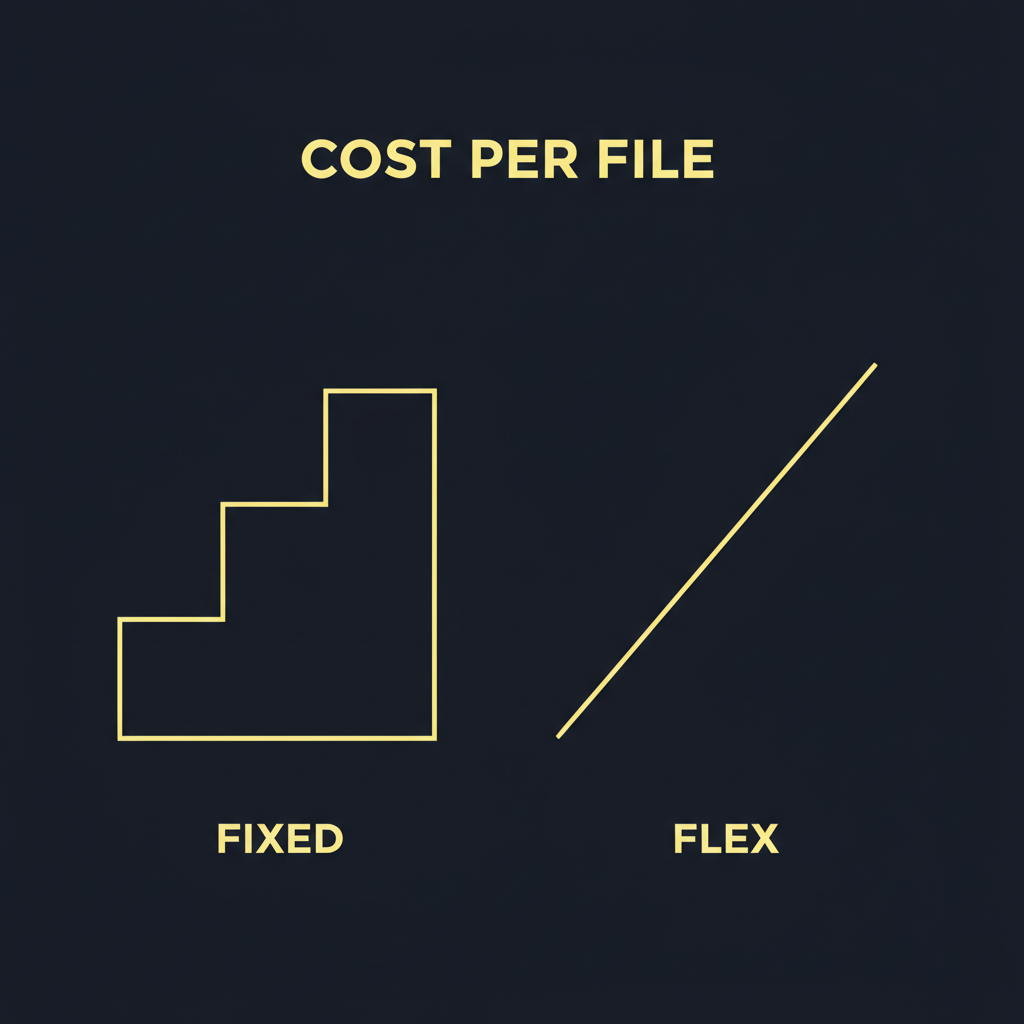
The fundamental shift is converting fixed headcount into variable cost per completed verification. You stop paying for idle researcher time during slow periods, and you stop scrambling for overtime during surges. The cost scales linearly with volume instead of stepping up in expensive increments every time you need to hire.
Outsourcing also gives you something in-house teams structurally cannot provide: the ability to absorb 2x or 5x volume overnight with zero ramp-up time. No hiring, no onboarding, no weeks spent training new researchers on FCRA requirements and employer contact workflows. The provider absorbs the surge, not your team.
With a pay-on-success pricing model, you only pay for verifications that actually complete. Failed attempts, voicemails that go unreturned, and disconnected numbers don't hit your budget. This transfers the risk of hard-to-reach employers from your team to the provider.
The average cost per hire reached $5,475 in 2025 (SHRM). Verification is a small fraction of that number, but it's one of the few components where outsourcing can produce immediate, measurable savings without changing your hiring workflow.
What Automated Verification Actually Replaces
AI-powered verification agents handle the exact tasks that make manual research so labor-intensive: dialing employers, sending email requests, transmitting fax forms, and following up on non-responses. These systems run unlimited simultaneous outbound attempts across phone, email, and fax channels. A human researcher works sequentially, one call at a time, capped at maybe 8 to 12 completed contacts per hour. An AI platform has no such ceiling.
That unlimited concurrency is the core scaling mechanism. When your volume doubles, the platform simply doubles its active outreach without queuing or delay. No additional staffing decisions, no capacity planning, no degradation in turnaround time.
The specific bottleneck being solved is the hard-to-reach employer problem. When a small business has no dedicated HR line, manual researchers often cycle through multiple contact attempts over several days. AI agents with access to contact databases covering roughly 100 million businesses worldwide can identify alternate numbers, direct emails, and secondary contacts without manual research time.
Automated platforms have compressed average verification timelines from 5 to 7 business days down to 24 to 48 hours (gcheck.com). Superunit's data shows an even faster average of 0.82 business days, with 65% of verifications completing within 24 hours and 80% within 48 hours (Superunit). The speed gain comes from parallelized outreach, not from cutting corners on documentation.

How to Calculate Your ROI Before Switching
Start with your current fully burdened cost per verification. Add up researcher salaries, benefits, management time, software subscriptions, phone costs, and database access fees. Divide by total completed verifications per month. Most teams land somewhere between $15 and $40 per completed verification when they're honest about overhead allocation.
Compare that number against a pay-on-success model where you only pay for completions. If a provider charges a fraction of your internal cost and delivers 70% completion rates at an average turnaround of 0.82 business days (Superunit), the math is straightforward. An 80% cost reduction against your current spend is achievable when you eliminate the fixed costs of idle staff, training, and technology maintenance.
Factor in the indirect savings too. Faster verifications mean faster offer-to-start timelines, which reduces candidate drop-off. Freed-up staff hours can be redirected toward compliance audits, candidate experience improvements, or other work that generates strategic value rather than just completing a checklist.
How to Evaluate Verification Vendors
Completion Rate and Coverage
Completion rate is the single most important metric, and it's the one most vendors are least transparent about. If a provider only queries The Work Number, you're looking at 30 to 35% coverage (Orsus Group). The remaining 65 to 70% of employers require active outreach, and your vendor needs a clear methodology for reaching them.
Target vendors that demonstrate 60% or higher completion rates on the manual portion of the verification workload. Ask for completion rate data segmented by employer size and industry, since a vendor that performs well on Fortune 500 employers but poorly on small businesses isn't solving your hardest problem.
Turnaround Time
The industry average for manual verification is 3 to 5 business days (InformData). Automated platforms should complete the majority of verifications within 24 hours. Ask vendors for median turnaround, not just average, since a few fast completions can mask a long tail of multi-day stalls.
Superunit reports 65% of verifications complete within 24 hours and 80% within 48 hours across 70,000+ processed verifications (Superunit). Those numbers represent a useful benchmark when comparing providers.
Compliance and Audit Documentation
FCRA governs all third-party background screening used for employment decisions. Annual compliance audits are recommended, and those audits should review your vendor's disclosure processes, adverse action workflows, and chain-of-custody documentation (Cisive).
Your vendor must provide compliance documentation that you can rely on if challenged (AMS Inform). Look for providers that record and transcribe every call, email, and fax interaction with timestamps. Compliance is consistently ranked as the top vendor selection criterion (SHRM), and for good reason: a single FCRA violation can trigger individual lawsuits and class actions.
Cost Model
Pay-on-success pricing (variable, per completed verification) carries lower risk than subscription or fixed-minimum models. Variable pricing protects you during slow months and eliminates the sunk cost of paying for incomplete work.
Fixed-minimum contracts make sense if your volume is highly predictable. For most CRAs and enterprise HR teams with seasonal hiring patterns, variable pricing produces better cost alignment with actual output.
Integration and Scalability
High-volume CRAs need API access to feed verification requests directly from their case management systems. ATS and HRIS integrations reduce manual data entry and the errors that come with it. Ask whether the vendor can accept and return data through your existing tech stack without requiring a separate login or manual upload process.
Scalability means handling volume spikes without degradation in turnaround or completion rates. Providers that run unlimited simultaneous outbound attempts solve the peak-period problem that forces in-house teams into overtime. If your volume doubles in Q1, the vendor should absorb that without renegotiating terms.
Common Objections to Outsourcing Verification
"We'll Lose Control Over Quality"
The opposite is usually true. In-house researchers take handwritten notes or type summaries into a CRM. Outsourced verification platforms that record, transcribe, and timestamp every employer interaction produce a more complete and auditable record than most internal teams maintain. You gain visibility into the exact conversation that confirmed employment dates and titles.
"Our Employers Are Too Hard to Reach"
Hard-to-reach employers are precisely where outsourcing delivers the most value. AI agents that simultaneously attempt phone, email, and fax outreach across contact databases covering 100 million businesses can identify and reach employers that would take a human researcher days to track down. The 62% completion rate benchmark across Superunit's verification volume (Superunit) includes these difficult cases.
"We'll Lose Surge Capacity"
The fear is that handing off verification to a third party means losing the ability to ramp up quickly when volume spikes. The reality is the opposite: outsourcing IS your surge capacity. An in-house team is structurally capped by how many researchers you've hired and trained, which means every spike requires a staffing decision weeks or months before the volume actually arrives.
A provider running AI-powered parallel outreach absorbs 2x, 5x, or 10x your normal volume without any action on your part. That elastic scale is something no internal team can replicate, regardless of budget. You get instant capacity that would take months to build organically.
"It's Too Expensive"
Compare the per-verification outsourcing cost against your fully burdened internal cost, not just against the sticker price of a database lookup. When you account for researcher salaries, benefits, training, management time, and technology costs, most organizations discover their internal cost per completed verification is substantially higher than they assumed. At scale, outsourcing typically wins the math.
How to Transition Your Verification Workflow
Start by auditing your current verification volume, cost, and turnaround time for the past six months. Segment the data by employer type: large employers in automated databases versus small or mid-size employers requiring manual outreach. The manual segment is where outsourcing delivers the fastest payback.
Run a pilot on your hardest cases first. Route 100 to 200 hard-to-reach verifications to the prospective vendor and measure completion rate, average turnaround, and cost per completed verification against your baseline. Superunit reports a 98% pilot-to-full-time conversion rate (Superunit), which suggests most organizations see enough improvement during the pilot to justify full rollout.
After the pilot, expand gradually. Move additional volume to the vendor in stages, keeping your internal team engaged on exceptions and quality review during the transition. Within 60 to 90 days, you should have enough data to determine final staffing levels for your internal verification function.

What to Expect After Outsourcing
Set expectations around completion rates honestly. A 62% completion rate on manual verifications is a strong benchmark given that these are the employers who don't respond to database queries (Superunit). Some employers simply refuse to verify employment regardless of the method used.
Turnaround will improve significantly. Moving from a 3 to 5 day average to sub-1-day average on the majority of verifications compresses your overall hiring timeline. Candidates receive offers faster, and your operations team spends less time managing status inquiries from hiring managers.
Volume flexibility becomes a lasting operational advantage, not just a cost story. New client wins, seasonal hiring surges, and unexpected spikes in verification requests no longer require staffing decisions or capacity planning. Your verification throughput scales with demand automatically, which means your team can commit to turnaround SLAs with confidence regardless of what next quarter's volume looks like.
The compliance benefit often surprises teams the most. When every verification attempt is recorded, transcribed, and timestamped, your FCRA audit trail is built automatically. Internal teams that previously relied on manual notes and email chains find themselves with stronger documentation than they ever maintained on their own. Staff freed from verification calls can focus on dispute resolution, compliance monitoring, and process improvement, which are the areas where human judgment is actually necessary.