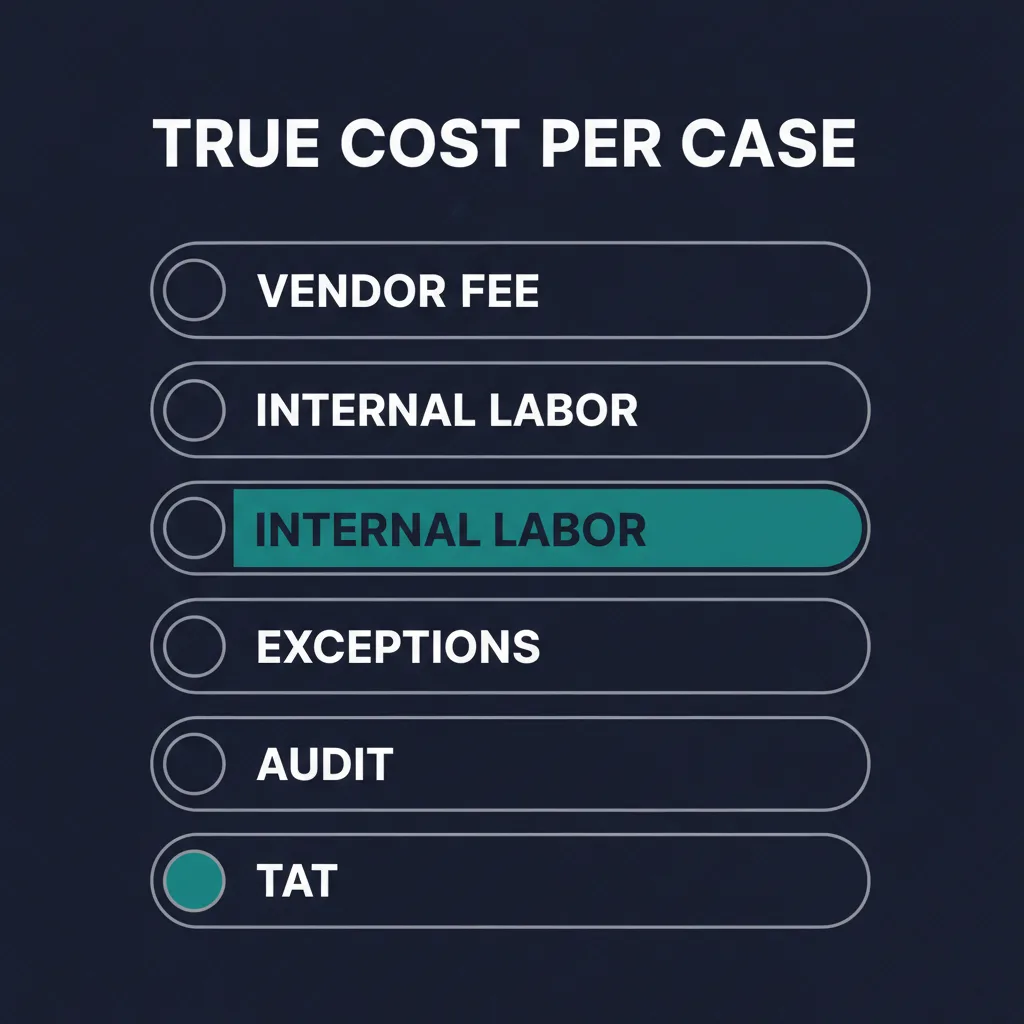
Two background screening operations teams pay identical $4 vendor invoices for employment verification. One runs $9 true cost-per-case. The other hits $18. The vendor isn't the difference — their internal operations are.
Your vendor invoice captures 30–40% of your real cost-per-case. The other 60–70% hides in internal labor, retry attempts, exception handling, audit-trail overhead, and the opportunity cost of slow turnaround times. Most ops directors budget against the invoice number and wonder why their unit economics don't add up.
In 2026, as verification volumes grow and labor costs climb, background screening operations need precise cost visibility to make smart vendor decisions and justify technology investments. The teams winning on unit economics measure all six cost components, not just the vendor line item.
This article delivers the 6-component framework for calculating true cost-per-case, plus a one-week measurement exercise you can run starting Monday. You'll discover which cost drivers matter most in your operation, where AI verification technology changes the math meaningfully, and the five vendor evaluation questions that surface hidden cost slices your procurement team probably missed.
Why Vendor Invoice Is the Wrong Number to Budget Against
The vendor invoice tells you what hits your accounts payable system. For most operations teams, that $4 or $7 or $12 line item becomes the unit cost they budget against and optimize around. This is the invoice illusion — mistaking the most visible cost component for the total cost.
Your true cost-per-case lives below the waterline. The vendor invoice represents roughly 30–40% of what each verification actually costs your operation. The remaining 60–70% gets buried across departmental budgets, absorbed into salary overhead, or never measured at all.
The hidden costs include the verification specialist who spends 12 minutes calling employers and logging results. The retry attempts when the first call fails. The escalations that require manager review or legal sign-off. The audit documentation and vendor management overhead that compliance demands. The opportunity cost when files sit in queue for three days instead of resolving in six hours.
These six cost components — vendor invoice, internal labor, retry cost, exception handling, audit overhead, and opportunity cost — form the complete picture. Most operations leaders have never calculated this total, which explains why cost-per-case estimates vary so wildly across similar teams, and why vendor switching often delivers disappointing savings.
The 6 Components of True Cost-Per-Case
Most operations teams track vendor invoices religiously but miss the other 70% of their true cost structure. The real cost-per-case calculation requires six distinct components, each with its own cost drivers and measurement challenges.
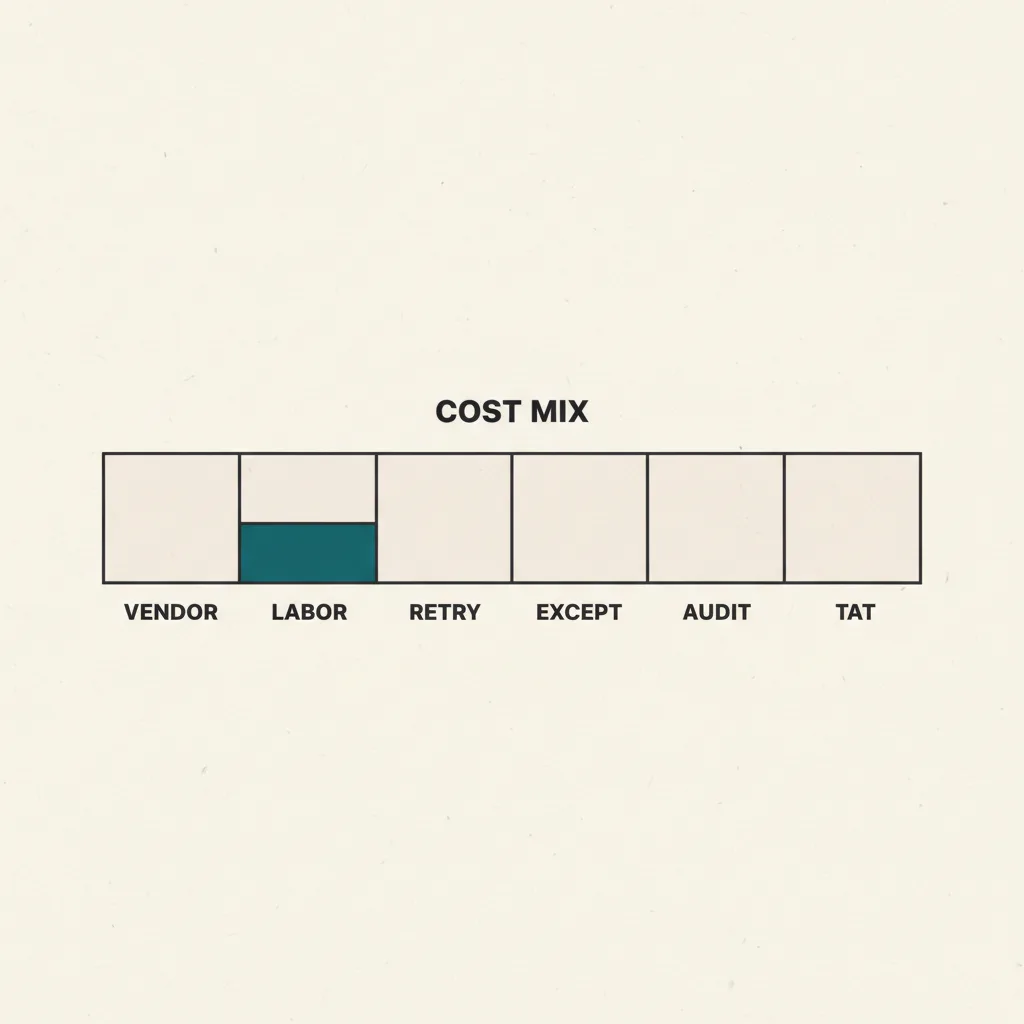
1. Vendor Invoice — The Visible Line
Your accounts payable system captures this component perfectly: the line-item charge from your verification vendor. This typically ranges from $2–$15 per case depending on verification method, employer difficulty, and service level agreements.
The invoice covers vendor labor, technology infrastructure, and profit margin. It excludes everything that happens on your side of the equation — which is most of what your operation actually pays for.
2. Internal Labor — Caller Time, Exception Handling, QC
Calculate this as: (average minutes per case × fully-loaded hourly rate) ÷ 60. Industry-typical fully-loaded cost for a verification specialist runs $35–$55 per hour, including benefits, overhead, and management allocation.
A typical manual verification averaging 12 minutes of internal time at $45/hour costs $9.00 per case in labor. High-touch cases requiring multiple calls, supervisor escalations, or detailed documentation can double that figure. For context on the labor patterns underneath this number, see Manual Employment Verification for Background Screening.
3. Retry Cost — When the First Attempt Fails
Each retry adds incremental labor cost plus, in many vendor pricing models, an additional attempt fee. Most operations teams don't track retry rates separately, which creates a blind spot in unit economics.
High-retry environments — particularly those handling small employers or long-tail coverage — see retry rates of 30–50% of total cases. Each retry effectively multiplies your base cost structure. A case that starts at $6 total cost can balloon to $14–$18 after two failed attempts.
4. Exception Handling — Escalations and Disputes
Cases requiring manager review, legal assessment, or FCRA dispute response cost 3–5× the baseline case. Even at a 5% exception rate, these outliers create meaningful blended cost impact.
Exception handling covers discrepancy resolution, candidate dispute processing, and employer pushback scenarios. The labor intensity jumps dramatically compared to routine completions.
5. Audit-Trail and Compliance Overhead
Record-keeping, retention protocols, and vendor-management documentation create relatively fixed per-case costs. This overhead doesn't compress significantly with volume increases — you still need documentation, retention policies, and FCRA compliance workflows for every case that flows through.
Factor $1–$3 per case for compliance infrastructure. For a deeper look at what audit-grade documentation actually requires, see How AI-Powered Employment Verification Creates a Complete Audit Trail.
6. Opportunity Cost of Slow TAT
Files sitting in verification queues tie up downstream workflow capacity. In mortgage lending, this translates to rate-lock expirations and application drop-off. In background screening, it means offer rescissions and candidate ghosting.
This component proves hardest to quantify but creates real business impact. Each additional day in queue increases abandonment probability, particularly in competitive hiring markets. Treat it as the silent multiplier on every other cost — slow operations don't just cost more per case, they lose business volume entirely.
How to Calculate Your Own True Cost-Per-Case (a One-Week Exercise)
Most operations teams budget based on vendor invoices, then wonder why their actual spend runs 40–60% higher than projections. The gap lives in unmeasured internal costs that pile up case by case.
Here is a one-week exercise that will give you your real cost-per-case number. Pull 50 random employment verification cases from last month's completed files. For each case, log six data points in a simple spreadsheet:

- Column A: Vendor invoice amount for this case
- Column B: Total internal labor minutes (initial setup + follow-ups + QC)
- Column C: Number of retry attempts beyond the first
- Column D: Exception flag (Y/N for manager escalation, dispute handling, or legal review)
- Column E: Audit overhead allocation ($1–$3 per case for documentation, retention, vendor management)
- Column F: Total days this case spent in your queue before completion
Convert your labor minutes to dollars using your team's fully-loaded hourly rate — typically $35–$55 for verification specialists. Add retry costs by multiplying extra attempts by your vendor's per-attempt fee. Flag exception cases at 3–5× your baseline cost.
Sum all costs across the 50 cases, then divide by 50. This is your true cost-per-case, and it's usually 60–180% higher than the vendor invoice alone. Most teams have never run this calculation, which explains why manual employment verification operations consistently blow through budgets.
The number is almost always surprising — and it becomes your baseline for evaluating process improvements or vendor alternatives.
Where AI Verification Changes the Math (and Where It Doesn't)
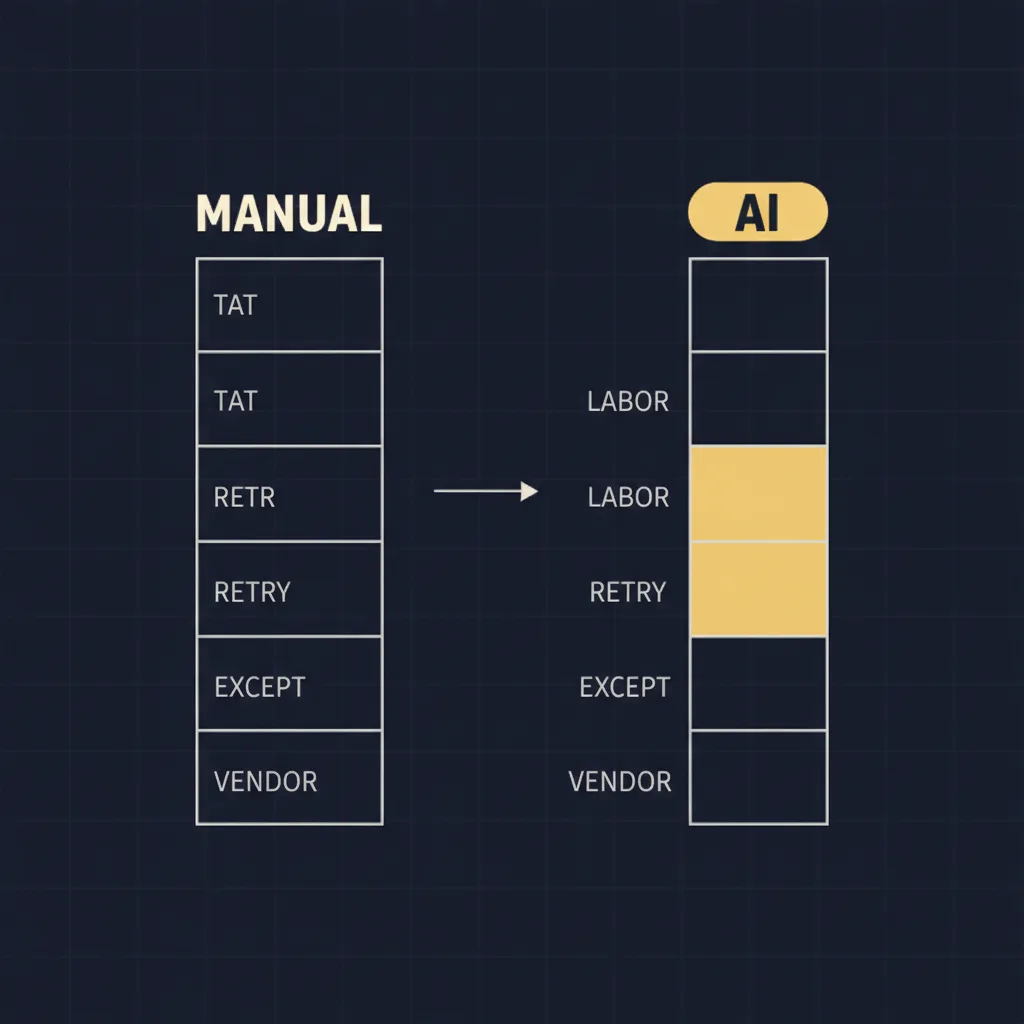
AI verification hits three of the six cost components hard, leaves two mostly untouched, and produces mixed results on the sixth. The math changes most dramatically for Component 2 (internal labor), Component 3 (retry cost), and the manual portions of Component 4 (exception handling).
Where AI Compresses Costs
Internal labor drops when AI handles initial outreach, follow-up calls, and basic data collection without human intervention. Industry-typical results show 60–80% reduction in caller minutes per standard case. A team spending $9.00 in internal labor per case might see that compress to $2–$4.
Retry cost shrinks because AI systems can attempt multiple contact methods simultaneously and operate outside business hours. Manual callers typically retry during the same 9-to-5 window when HR departments are already overloaded. AI attempts evening calls, weekend faxes, and follow-up email outreach when response rates are often higher.
Exception handling becomes partially automated when AI can resolve common discrepancies — job title variations or employment date ranges within tolerance thresholds — within structured logic. The complex exceptions still require human escalation, but routine variances get filtered out before reaching your team.
Where AI Shows Minimal Impact
Vendor invoice costs remain similar whether you're paying for human callers or AI attempts. Some AI vendors charge slightly less per case, others slightly more — the difference rarely exceeds $1–$2 per verification.
Audit-trail and compliance overhead stays largely fixed. You still need documentation, retention policies, and FCRA compliance workflows. AI may generate cleaner audit trails by structural output rather than manual assembly, but the per-case compliance burden doesn't compress meaningfully.
The Wild Card: Opportunity Cost
TAT improvement varies dramatically by AI implementation. Teams that see 3-day average completion times drop to same-day processing capture real opportunity cost savings. Teams that see modest TAT gains — perhaps 4 days to 3 days — experience limited downstream workflow benefits.
The honest assessment: AI verification typically reduces total cost-per-case by 25–45% in high-labor environments and 15–30% in already-efficient operations. Results depend heavily on your current retry rates and internal labor allocation.
The Two Ops Profiles Where AI Tools Like Superunit Reshape Unit Economics
AI verification delivers the biggest unit economics impact in two specific operational profiles. Outside these scenarios, the cost improvements are real but more modest.
Profile 1: High-Retry Environments
Operations handling small employers and long-tail coverage see retry rates between 30–50% of cases. Each retry adds incremental vendor cost plus another 8–12 minutes of internal labor. A case that starts at $6 total cost can balloon to $14–$18 after two failed attempts.
AI verification attacks this problem directly by working multiple channels in parallel — phone, email, fax — rather than sequencing them one at a time. Operations teams report retry reductions from 40% down to 12–15% when AI successfully reaches employment data on the first pass. The math is compelling: drop your retry rate by 25 percentage points and your blended cost-per-case falls by $3–$5. For a deeper look at this exact workflow, see How CRAs Handle the Long Tail of Unresponsive Employers.
Profile 2: High-Labor Environments
Manual caller teams burn 15–20 minutes per case on average — phone tag, hold times, multiple attempts to reach the right HR contact. At a fully-loaded cost of $45/hour, that's $11–$15 in internal labor per case before vendor fees.
AI verification compresses this to 2–3 minutes of specialist time for case setup and results review. The labor savings are immediate and measurable: $9–$12 per case reduction in internal cost. Teams outsourcing verification work see similar compression when vendor teams deploy AI tools.
When AI Impact Remains Modest
If your operation runs low retry rates (under 15%) and minimal internal labor per case (under 8 minutes), AI verification improves TAT and accuracy but won't reshape your unit economics. The cost reduction might be $1–$2 per case rather than $5–$10. In that scenario, consider whether outsourcing the verification function entirely is a better fit than investing in internal AI tooling.
Vendor Evaluation Questions That Surface Hidden Slices
Most procurement conversations focus on vendor invoice rates while ignoring the hidden costs that determine your real unit economics. These five questions force vendors to reveal how their pricing model affects your total cost-per-case across all six components.
1. Do you charge per attempt or per completed case? Per-attempt pricing creates unpredictable retry costs that can double your vendor spend. A $4 per-attempt vendor becomes $12 per case when three attempts are needed. Per-completed-case pricing shifts retry risk to the vendor, making your Component 1 costs predictable even in high-retry environments.
2. What is your retry policy and how are retries billed? Some vendors include multiple attempts in their base price; others charge separately for each. The difference matters enormously for long-tail employer coverage. If 40% of your cases need retries, a vendor with inclusive retry pricing delivers 15–20% lower Component 3 costs than one charging separately.
3. What exception types does your team handle vs. mine? Vendors who escalate HR disputes, employment-gap questions, and title mismatches back to you preserve their margins while inflating your Component 4 costs. The best vendors absorb common exceptions into their workflow, reducing your internal labor overhead by 25–35% per case.
4. What does your audit trail include by default? Basic vendors provide timestamps and contact outcomes. Premium vendors include call recordings, email threads, and dispute-resolution documentation that satisfies FCRA requirements without additional internal work. This directly reduces your Component 5 compliance overhead.
5. What is your reported median completion time (not best-case)? Marketing materials cite 24–48 hour TAT while real performance often runs 4–6 business days. Slow completion times increase Component 6 opportunity costs and create downstream bottlenecks in your adjudication workflow. Demand median completion data, not averages skewed by easy cases.
These questions reveal whether a vendor's true economics align with reducing your total cost-per-case or simply optimizing their invoice line. For a structured way to run vendor evaluations end-to-end, see Best Employment Verification Software for CRAs (2026).
Frequently Asked Questions
What is a typical true cost-per-case for employment verification?
Most background screening operations see true cost-per-case between $8 and $25 when you factor in all six components. The vendor invoice ($2–$15) typically represents only 30–40% of total cost. High-retry environments with manual calling teams cluster at the upper end. Low-touch operations with strong employer coverage and AI-assisted outreach cluster around $8–$12 per completed case.
Why is the vendor invoice not the same as true cost-per-case?
The vendor invoice excludes your internal labor, retry attempts, exception handling, audit overhead, and the opportunity cost of slow turnaround. A $4 vendor invoice becomes $12 true cost when your team spends 15 minutes per case on calling, documentation, and QC. Most finance teams budget against the wrong number because they only see what hits accounts payable.
How does AI verification reduce cost-per-case?
AI primarily compresses internal labor (Component 2) and retry costs (Component 3) by automating initial outreach, working multiple channels in parallel, and reducing manual calling time. Typical reductions range from 25–45% on total cost-per-case in high-labor environments and 15–30% in already-efficient operations. AI has minimal impact on vendor fees, compliance overhead, or opportunity costs unless it significantly improves turnaround time.
What is the right way to calculate verification ROI?
Compare your current true cost-per-case against the projected cost with new tooling or vendors. Include implementation costs and training time in year-one calculations. Most teams focus only on labor savings, but faster turnaround time often delivers bigger ROI through reduced offer rescissions, fewer candidate drop-offs, and freed-up downstream capacity.
Should ops teams budget per attempt or per completed case?
Budget per completed case. Per-attempt pricing creates unpredictable costs when retry rates spike. Vendors with per-completion pricing have stronger incentives to invest in coverage and success rates. Per-attempt billing shifts retry risk to your budget — and that risk is bigger than most procurement teams realize until they run the one-week measurement exercise above.
Ready to Run the Numbers on Your Operation? See How Superunit Changes the Math
The framework in this article works whether you're running internal operations, evaluating vendor partnerships, or considering a hybrid approach. Most background screening operations directors discover their true cost-per-case runs 40–60% higher than their vendor invoice suggested — but they also find specific compression opportunities they hadn't considered before running the numbers.
Start with the one-week measurement exercise. Pull 50 cases, log the six components, calculate your baseline. The vendor evaluation questions will help you negotiate better terms once you understand where your hidden costs actually live.
To see how Superunit's AI verification agent changes the math for your specific case mix and volume profile, request a demo.