
A fake pay stub takes about five minutes and a few dollars to produce. Security firm Resistant AI has catalogued more than 150 online pay stub generators (the top twenty drew over 10 million visits in 2025), selling professional-looking stubs for $4 to $35 each, most under $10, with unlimited-stub subscriptions from $3–$7 a month. Most are marketed as "novelty" products, and the output has gotten clean enough that the classic advice for spotting a fake pay stub ("look for blurry logos and bad fonts") mostly catches the lazy ones. The good ones pass the eyeball test.
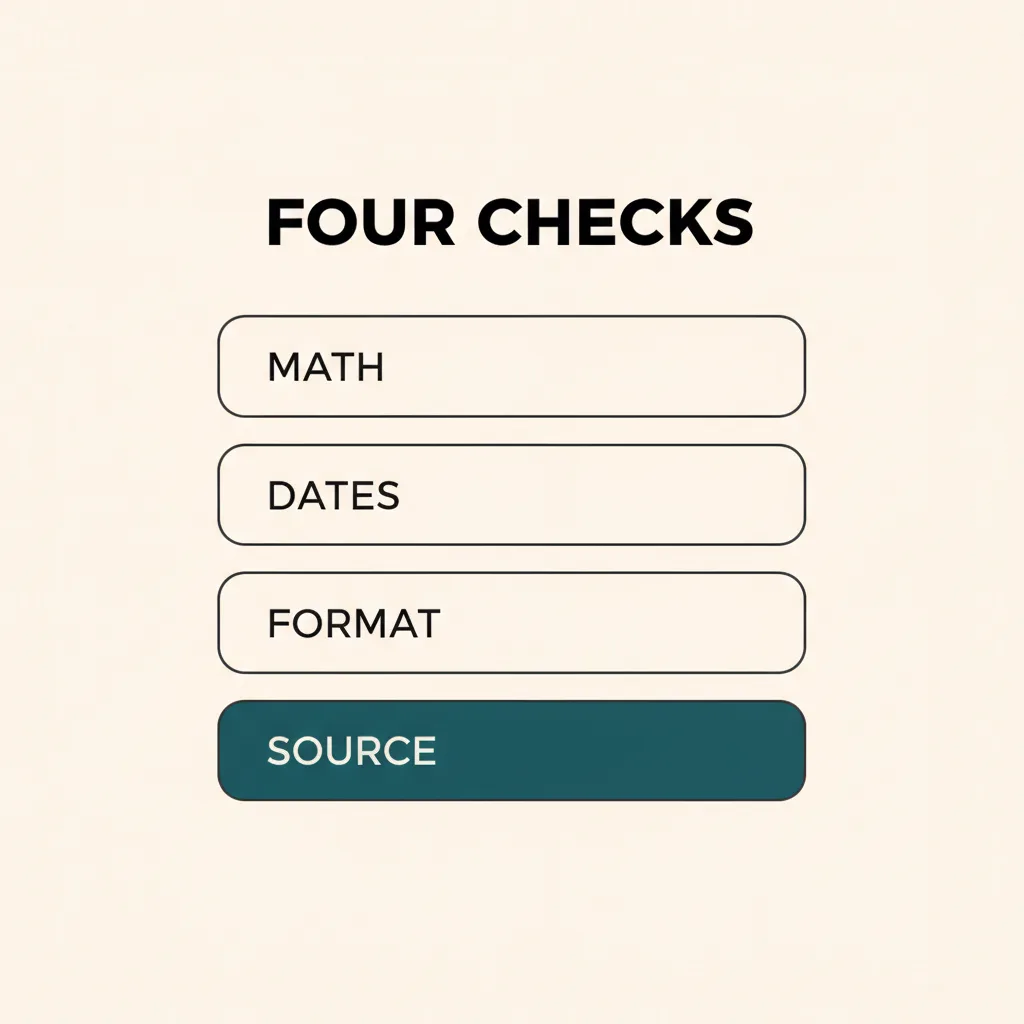
You can still catch most of them, because fabricated stubs fail in predictable places: the math, the dates, the formatting details generators get subtly wrong, and — decisively — the employer behind the document. This checklist runs in that order, from the checks a leasing agent can do in two minutes to the one that settles the question.
TL;DR: To spot a fake pay stub, check the math first (gross-to-net and year-to-date totals are where fakes break), then the dates (pay periods that don't line up with a real calendar), then the formatting (rounded numbers, generic templates, missing employer identifiers). But treat document review as a filter, not a verdict: a pixel-perfect stub can describe a job that doesn't exist. The only check that closes the question is confirming employment and income with the employer at an independently sourced contact, which is what source verification means.
The 11 Tells, in the Order to Check Them
The math (catches the most fakes)
1. Year-to-date totals that don't reconcile. YTD gross should equal roughly the gross per period times the number of periods elapsed. Generators let users type any YTD figure, and most users don't do the multiplication. A stub dated in October showing a biweekly gross of $2,400 and YTD gross of $31,000 doesn't reconcile against roughly 20 elapsed pay periods — real payroll systems compute this and are never wrong.
2. Net pay that doesn't follow from the deductions. Gross minus the itemized taxes and deductions must equal net, to the cent. Fabricators fill fields independently and the subtraction fails.
3. Withholding that makes no sense for the income. Federal withholding, Social Security (6.2% up to the annual wage base), and Medicare (1.45%) sit in narrow, computable ranges. A $95,000 salary showing $40 of federal withholding per period is a typed number, not a calculated one.
4. Perfectly round numbers everywhere. Real payroll produces amounts like $2,417.83. A stub where gross, taxes, and net are all round hundreds reads as invented. (Round salary figures are normal; round everything is not.)
The dates
5. Pay periods that don't match a real calendar. Biweekly stubs land on the same weekday; semi-monthly stubs land on fixed dates. A "biweekly" stub whose period ends jump between weekdays wasn't produced by a payroll run.
6. Pay date before the period ends, or on a weekend/holiday for an employer that wouldn't pay on one. Small anachronisms accumulate in fabricated sequences, especially when someone generates several stubs at once.
7. A hire story that conflicts with the YTD. A stated start date three months ago with a full year of YTD earnings on the stub is a story problem the applicant has to answer.
The format and the employer block
8. Generic template artifacts. Identical layouts recur across generator output: the same fonts, the same field order, the same placeholder-ish design. Document-fraud software fingerprints these templates at scale; it's the strongest argument for running submitted documents through detection software rather than eyeballing them.
9. Missing or wrong employer identifiers. Real stubs typically carry the employer's legal name, address, and often an EIN, plus a payroll provider's mark (ADP, Paychex, Gusto, Workday). Verify the employer's address and phone exist independently (a registered business with a live phone line) rather than trusting what's printed.
10. The applicant's details subtly off. Misspelled names, an address that doesn't match the application, an abbreviated employer name that doesn't match any registered entity.
11. Metadata, if you have the file. A PDF whose producer string is an online stub generator, a creation date minutes before submission, or editing-tool traces. This is exactly what detection software automates.

The Uncomfortable Part: A Perfect Stub Can Still Be a Lie
Every check above interrogates the document. None of them interrogates the job.
That gap is where the sophisticated fraud lives. A stub can be mathematically consistent, correctly dated, professionally formatted — and describe employment that ended two months ago, a salary inflated by a cooperative "employer," or a shell company whose only assets are a business registration and someone willing to answer its phone. Fraud rings that operate at this level don't make font mistakes; they submit documents that are real in every sense except the facts.

Document review and fraud-detection software filter out the fabrications. What's left — the plausible documents — is exactly the population where the remaining risk concentrates, and the only test that reaches it is independent confirmation with the employer: does this person work there, in this role, at this income, today? Our guide to rental application fraud covers how often the answer surprises leasing teams.
How Superunit Confirms the Employer Behind the Document
Superunit runs that confirmation as an automated step. Its AI agents look up the employer's contact information independently (never from the document or the application), then call, email, and fax in parallel until they reach a person who can confirm employment, title, dates, and income where disclosed. Every attempt is timestamped; calls are recorded and transcribed; and the result is a documented verification rather than a leasing agent's note.
What a Superunit Verification Adds to the File
Half of outreach verifications complete within 24 hours, three-quarters within 48 (inside a leasing window), and pricing is per completed result. Across more than 200,000 verifications, the pattern repeats: the documents most worth verifying are the ones that looked fine.
For screening operators, the practical design is layered: document checks and detection software on everything, employer outreach on everything the fast layers can't settle: new hires with offer letters, applicants who won't connect payroll, documents that pass but tell a convenient story. See how it works for tenant screening.
Frequently Asked Questions
What's the fastest single check for a fake pay stub? Reconcile the year-to-date totals. YTD gross should equal per-period gross times elapsed periods, and gross minus itemized deductions must equal net to the cent. Fabricated stubs fail these more than any other check because generators let users type figures independently.
Are fake pay stubs illegal? Producing a fake stub to obtain a lease, loan, or credit is fraud, and using one can expose the applicant to civil liability and criminal charges depending on jurisdiction. The generator sites themselves typically disclaim "novelty use," which does not protect the person who submits one.
Can software detect fake pay stubs automatically? Yes: document fraud detection tools fingerprint generator templates, spot edits, and read file metadata at scale, and they catch far more than manual review. What they can't do is confirm the job behind an authentic-looking document; that requires contacting the employer.
Should landlords verify pay stubs with the employer? For any application where the decision rides on the income: yes. Use a phone number sourced independently (not the one on the application or the stub), confirm employment status, title, start date, and income where the employer discloses it, and document the attempt.
What if the employer won't respond to a verification request? Document the attempts and use your policy's alternatives: additional documents like tax transcripts or bank statements, a guarantor, or an extended review window. A documented non-response supports whatever decision follows; a silent skip doesn't.
Check the Document, Then Check the Job
The checklist above will catch most fakes in the first four minutes — the math and the calendar do the heavy lifting. Run detection software if you're screening at volume. And for the applications that matter, close the loop the fraud can't survive: a verified conversation with the employer. Documents describe employment; employers confirm it.