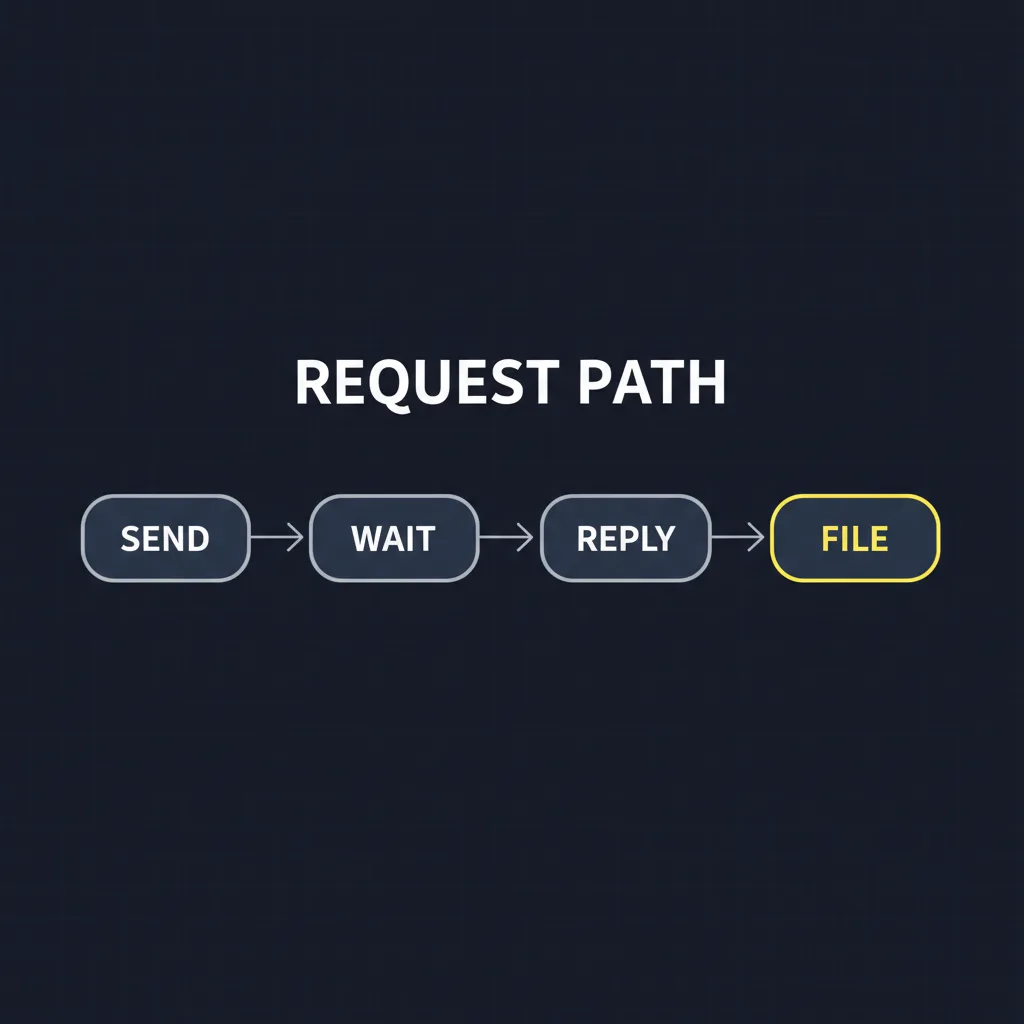
Most §391.23 guidance explains the regulation. Very little of it shows you the actual artifact: the request you put in front of a previous employer, what has to be on it, and what you do with it for the next thirty days.
This is that piece. It assumes you already know why the safety performance history investigation exists. If you need the underlying workflow first, start with our guide to executing FMCSA-compliant DOT previous employment verification, then come back here for the request itself.
TL;DR
- A §391.23 safety performance history records request is a written inquiry sent to every DOT-regulated employer a driver applicant worked for in the preceding three years. It covers general employment verification and accident history as defined in 49 CFR 390.5.
- FMCSA does not publish a mandatory form. Carriers and CRAs use their own templates, which is why so many of the ones circulating online are out of date.
- The 30-day response obligation under §391.23(d) starts when the previous employer receives the request, not when you send it. Capture delivery evidence on every channel you use.
- Drug and alcohol violation history no longer belongs on a CDL request. The FMCSA Clearinghouse has covered that check since January 6, 2023, though the previous-employer inquiry under 49 CFR Part 40.25 still applies for other DOT modes, including PHMSA.
- Non-response is not automatically a compliance failure, but undocumented non-response is. Log every attempt with date, channel, and outcome, record a terminal disposition for each request, and give recipients a no-record checkbox so silence becomes a filed answer.
What the Records Request Actually Is
A safety performance history records request is the written inquiry a prospective employer sends to each of a driver applicant's DOT-regulated previous employers from the preceding three years, under 49 CFR 391.23.
It is a different document from the employment application, and a different thing from a general employment verification. The regulation sets its scope, its recipient, and a response deadline that binds the employer receiving it.
The request has to be in writing and it has to be documented. A phone call that produces a verbal answer does not satisfy §391.23 on its own. The call is how you chase the written request.
What the Request Must Cover
Under §391.23(d), the safety performance history investigation reaches two categories from each DOT-regulated employer in the preceding three years:
- General employment verification: dates of employment and whether the applicant held a safety-sensitive position.
- Accident history: accidents as defined in 49 CFR 390.5 that the applicant was involved in during that period, plus any other accidents the employer retained under its internal policies.
A third category used to belong here. Drug and alcohol violation history was historically obtained through this same inquiry under §391.23(e). Since January 6, 2023, employers query the FMCSA Drug and Alcohol Clearinghouse for the pre-employment drug and alcohol history check on CDL drivers instead of sending three-year inquiries to previous DOT employers.
Plenty of templates still circulating online get this wrong. If your request form asks previous employers for drug and alcohol testing records on a CDL applicant, you are asking for something the Clearinghouse now covers, and you may be building a file that looks like it substituted an employer response for a required Clearinghouse query.
The Clearinghouse only covers FMCSA, though. If you screen for safety-sensitive positions under other DOT modes, PHMSA-regulated pipeline and hazardous materials work among them, the previous-employer drug and alcohol inquiry under 49 CFR Part 40.25 still applies there, and lookback windows differ by mode. Check your own scope with compliance counsel before you retire anything from a template.
A Copy-Paste Safety Performance History Request
Adapt the bracketed fields. Send on company letterhead where you can. Small carriers respond better to a request that looks institutional than to something that reads like a form email.
SAFETY PERFORMANCE HISTORY RECORDS REQUEST
Pursuant to 49 CFR § 391.23

DATE: [Date sent]
TO: [Previous employer legal name]
     [Address / fax / email]
FROM: [Your company name, USDOT number]
       [Return address, phone, fax, email]

RE: Safety Performance History — [Applicant full name]
     Date of birth: [DOB]
     Driver's license number / state: [DL# / ST]
     Dates of employment as reported by applicant: [MM/YYYY – MM/YYYY]

We are a prospective employer of the individual named above and are
conducting the investigation required by 49 CFR § 391.23. A signed
release authorizing this request is attached.

Under § 391.23(d), you are required to respond within 30 days of
receiving this request. Please provide the following:

1. GENERAL EMPLOYMENT VERIFICATION
   a. Dates of employment: ____________ to ____________
   b. Did the applicant perform a safety-sensitive function?  Y / N
   c. Position(s) held: ______________________________

2. ACCIDENT HISTORY (preceding 3 years)
   For each accident as defined in 49 CFR § 390.5:
   a. Date: __________  Location: ______________________
   b. Number of injuries: ______  Number of fatalities: ______
   c. Hazardous material released (other than fuel from the
      vehicle's own tank):  Y / N
   d. Any additional accidents retained under your internal
      policies: ______________________________________

If you have no record of this individual as an employee, please
indicate so below and return this form.

   [ ] No record of employment for this individual.

Completed by: ______________________  Title: ________________
Signature: _________________________  Date: _________________
Phone: _____________________________

RETURN TO: [fax number] | [email address] | [mailing address]

Attachment: Signed applicant release
The template does two things on purpose. It puts the 30-day obligation on the face of the document, which helps with employers who don't know they have one. And it gives the recipient a no-record checkbox, which turns a share of otherwise-silent non-responses into a returned, filed answer.
Prefer a formatted file? The download mirrors the request above as a fillable one-page form, with a letterhead band you can swap for your own, checkbox fields for the safety-sensitive and hazmat questions, a signature block for the responding employer, and the no-record option built in.
Download the §391.23 request form (.docx)
Where and How to Send It
Fax is still the highest-response channel for small motor carriers. That is an uncomfortable fact and a persistent one, and we have written separately on why fax still matters in verification workflows.
Dispatch on every available channel on day one instead of escalating one at a time. Fax to the number on the carrier's FMCSA registration if it is listed. Email any published safety or HR address. Mail the carriers with no reachable electronic channel. Call on day one as well, to confirm the request arrived and reached someone who knows what it is. The call is not where you take the answer.
Sending on three channels at once costs almost nothing, and it compresses turnaround considerably against waiting ten days for a fax to fail before you try email.
How the 30-Day Clock Actually Runs
Under §391.23(d) the previous employer responds within 30 days of receiving the request. The clock starts on receipt, not on your send date, and you generally cannot prove receipt unless you captured something: a fax confirmation, a delivery receipt, a logged phone confirmation.
A workable internal cadence inside that window:
| Day | Action |
|---|---|
| 1 | Dispatch on all available channels; log every send with timestamp |
| 1–2 | Confirmation call to verify the request arrived and reached the right desk |
| 10 | First follow-up on the channel most likely to have landed |
| 20 | Second follow-up; attempt an alternate contact or named individual |
| 30 | Document non-response; begin good-faith closure sequence |
Your onboarding timeline is almost never 30 days, so this cadence has to run alongside everything else in the qualification file instead of gating it.
The Request Log That Survives an Audit
A reviewer assessing your §391.23 compliance wants a traceable record for each request, not an assurance that you have a process. The log fields that matter:
- Applicant name and previous employer legal name
- Date the request was sent, per channel, with confirmation artifacts attached
- Date receipt was confirmed and how
- Every follow-up attempt with date, channel, and outcome
- Response received date, and the response document itself
- Terminal disposition: responded, no-record returned, refused, defunct, or non-responsive after documented good-faith effort
Most logs omit that last field, and reviewers probe it. For the broader file structure this feeds, see building a DOT driver qualification file audit trail, and for how reviewers interrogate these records in practice, what FMCSA audit reviewers look for. To see where this request sits among every other record an investigator will ask for, work through the DOT compliance checklist.
When the Previous Employer Never Responds
Non-response is common and it is not automatically a compliance failure. Undocumented non-response is what fails.
A defensible closure sequence shows that the request was properly addressed and delivered, that follow-up was genuine and varied, and that you recorded the outcome. Four situations come up often enough to keep a rule for each.
A defunct carrier: confirm dissolution against the state registry or FMCSA registration status and attach the evidence. A confirmed-defunct entry is a closed entry.
An acquired carrier: records usually transfer with the acquisition, so identify the successor and re-issue the request instead of closing the entry as unreachable.
A blanket refusal: some employers refuse on policy. Document the date, the name of the person who stated it, and the reason they gave.
A wrong employer: a returned no-record checkbox on a correctly addressed request is a real finding about the applicant's stated history, and it should go for review rather than into the file unremarked.
How Superunit Completes a DOT Verification
Superunit's AI agents do the job a verification coordinator would otherwise do by hand. They call the previous employer, work through the phone tree, wait on hold, send and re-send by email and fax, read whatever comes back including returned PDFs, and keep working the request until they get an answer or the channel is genuinely exhausted.
On a DOT file the agents collect all three record sets the driver qualification file needs: employment verification, the three-year accident history required under §391.23, and drug and alcohol history where a previous-employer inquiry still applies.
That last one depends on the mode. For CDL drivers under FMCSA, drug and alcohol violation history comes from the Clearinghouse and not from previous employers. For safety-sensitive positions under other DOT modes, including PHMSA-regulated pipeline and hazardous materials operations, the previous-employer inquiry under 49 CFR Part 40.25 still applies, because the Clearinghouse only covers FMCSA. Superunit runs that inquiry wherever it is required.
Mechanically it is the same outreach engine behind our VOE product, pointed at the FMCSA record set instead of a lender's. Same calls, same kind of HR desk, more fields on the form.
Where Superunit Publishes the Results
Whatever comes back, a completed form or a faxed letter or a verbal confirmation or a no-record response, gets captured as a structured result and published straight into the client's system with the source document attached.
Nobody on your side retypes anything. The agent makes the calls, captures the fields, and the finished record lands in your DQ file workflow the same way a VOE result lands in a loan file. Superunit has completed more than 200,000 verifications across employment, income, and DOT files.
If you are evaluating tooling for this instead of building it, our comparison of the best DOT employment verification software for FMCSA compliance goes through the options.
Frequently Asked Questions
Is there an official FMCSA safety performance history request form? No. FMCSA specifies the required content in §391.23 but does not publish a mandatory form. Carriers and CRAs use their own templates. What matters at audit is that the request covers the required elements, that a signed release is attached, and that the exchange is documented.
Does the previous employer have to respond? Yes. Under §391.23(d), a DOT-regulated previous employer must respond within 30 days of receiving the request. Enforcement of that obligation is limited in practice, which is why your good-faith documentation carries the weight when they don't.
Do we still ask previous employers for drug and alcohol testing history? For CDL drivers under FMCSA, the Clearinghouse query has covered the pre-employment drug and alcohol history check since January 6, 2023, so that element no longer goes to previous employers. For safety-sensitive positions under other DOT modes, PHMSA among them, the previous-employer inquiry under 49 CFR Part 40.25 still applies, since the Clearinghouse is FMCSA-only. Confirm which modes you screen for with your compliance counsel.
Can we send the request by email instead of fax? Yes. The regulation requires a written request, not a specific channel. Send on every channel available and log each one. Fax still produces the best response rates from small carriers.
How long do we retain these records? Safety performance history records obtained under §391.23 are subject to the retention requirements in §391.53 and the broader DQ file retention rules in §391.51. Retain the request, the response, and the full attempt log together.
What if the applicant disputes what a previous employer reported? §391.23 provides a rebuttal process. The applicant must be able to review the information received and submit a rebuttal, and the prospective employer must attach the rebuttal to the file and forward it to the previous employer.
The Document Is the Deliverable
At audit, the safety performance history investigation comes down to a stack of artifacts: a request that covered the required elements, evidence it was delivered, a log of what happened next, and a disposition for every entry.
Start from a stale template that asks for Clearinghouse-covered data, with no no-record checkbox and no delivery evidence, and even a diligent team ends up with a file that reads as incomplete.
If chasing these requests eats your safety department every hiring cycle, see how Superunit handles DOT verification outreach.