
Search for a DOT compliance checklist and you will find a dozen bulleted lists that all cover roughly the same ground: keep your driver files, do your drug testing, log your hours. They are not wrong. They are just organized for a writer rather than for a reviewer.
An FMCSA investigator does not work through your operation alphabetically. They work through six record systems in a fairly predictable order, and they arrive already knowing which ones carriers get wrong. This checklist is arranged that way.
TL;DR
- DOT compliance for a motor carrier comes down to six record systems: driver qualification files, the drug and alcohol program, hours-of-service records, vehicle maintenance and inspection files, the accident register, and operating authority.
- The driver qualification file under 49 CFR §391.51 has eight required components. Most incomplete files are missing the §391.23 safety performance history investigation, not the paperwork the driver hands you.
- A new entrant safety audit and a compliance review are different events with different stakes. New entrants get audited within their first 12 months against a pass/fail standard.
- Sixteen specific violations listed in 49 CFR §385.321 fail a new entrant safety audit automatically, regardless of how good the rest of your operation looks.
- An incomplete DQ file is not itself on that automatic-failure list. But using a disqualified driver (§391.15(a)) or a medically unqualified one (§391.11(b)(4)) is, and those are exactly the conditions a complete DQ file exists to prevent.
The Six Record Systems
Everything an investigator asks for lives in one of six places. Knowing which system a document belongs to is most of what separates a binder that survives review from one that does not.
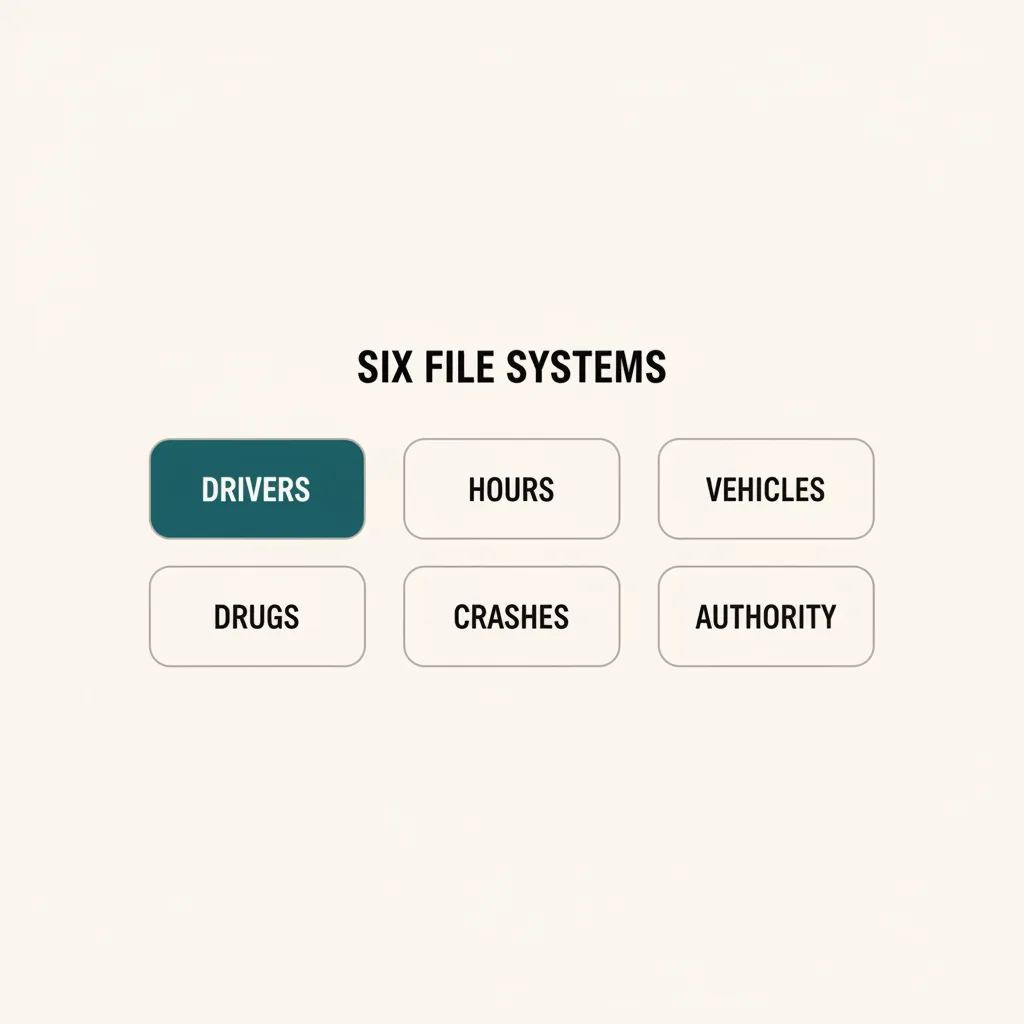
| System | Governing part | Core artifact | Retention |
|---|---|---|---|
| Driver qualification | 49 CFR Part 391 | DQ file per driver | Employment + 3 years |
| Drug and alcohol | 49 CFR Part 382 | Testing program, Clearinghouse queries | 1–5 years by record type |
| Hours of service | 49 CFR Part 395 | RODS and supporting documents | 6 months |
| Vehicle maintenance | 49 CFR Part 396 | Maintenance file per vehicle | 1 year + 6 months after disposal |
| Crashes | 49 CFR §390.15 | Accident register | 3 years per accident |
| Operating authority | 49 CFR Parts 387, 390 | Insurance filings, MCS-150 | Current |
Retention periods below reflect the regulations as written at publication. Confirm anything you are about to rely on against the current CFR, since parts of this framework move.
1. Driver Qualification Files
This is the system reviewers open first and the one that generates the most findings. Under §391.51(b), each driver's file must contain eight things:
- The employment application completed under §391.21
- A motor vehicle record from every state licensing authority where the driver held a license in the past three years, obtained under §391.23(a)(1)
- The road test certificate, or an equivalent license or certificate accepted in its place, or a written statement that the driver is exempt
- The MVR from the annual driving record inquiry under §391.25(a)
- The note documenting the annual review of the driving record under §391.25(c)(2)
- The medical examiner's certificate or a legible copy, and for CDL holders the CDLIS record showing medical certification status
- Any Skill Performance Evaluation certificate or federal medical variance
- A note verifying the medical examiner appeared on the National Registry at the time of the exam
Two retention rules apply on top of that list. Under §391.51(c) the file is kept for as long as the driver is employed and for three years after. Under §391.51(d), a subset of documents can be purged after three years: annual MVRs, annual review notes, medical certificates, medical variances, and the registry verification notes.
Note what is not on the list. The §391.23 safety performance history investigation is required, but it lives under §391.53 rather than inside the eight-item §391.51 inventory. Carriers who build their file structure straight off §391.51 sometimes end up with no home for it at all.
2. The §391.23 Investigation
Within 30 days of hiring a driver, two investigations have to be complete.
The first is the MVR check, which most carriers handle reliably because it is a database query with a vendor behind it.
The second is the safety performance history investigation, which is a written inquiry to every DOT-regulated employer the driver worked for in the preceding three years. It has to cover general employment verification and accident history as defined in §390.5. The previous employer is obligated under §391.23(d) to respond within 30 days of receiving the request.
This is where files go thin, for a structural reason: the first check is something you do, and the second is something you have to get someone else to do. Previous employers are small carriers with no dedicated HR desk, and they do not answer.
Non-response is not a compliance failure. Undocumented non-response is. What a reviewer wants is evidence of a genuine good-faith effort: the request itself, proof it was delivered, a log of follow-up attempts with dates and channels, and a terminal disposition for every entry.
For the mechanics of the request and a fillable template, see our guide to the DOT safety performance history records request. For how the two regulations combine into a single per-driver record, see building a DOT driver qualification file audit trail.
3. Drug and Alcohol Program
Part 382 obligations split into the program itself and the Clearinghouse.
The program requires a written policy distributed to every driver, a designated employer representative, supervisor reasonable-suspicion training, a testing consortium or in-house program, and pre-employment testing before a driver's first dispatch in a safety-sensitive function.
Random testing rates for 2026 hold at 50% for controlled substances and 10% for alcohol, unchanged for the seventh consecutive year. Those are annualized minimums against your average number of driver positions, and selections have to be spread across the year rather than clustered.
The Clearinghouse adds three separate obligations that carriers routinely conflate:
- A full pre-employment query before the driver performs any safety-sensitive function. Full queries require the driver's electronic consent inside the Clearinghouse itself.
- An annual query for every current CDL driver. This one can start as a limited query, but if it comes back indicating a record exists, §382.701(b)(3) requires a full query within 24 hours.
- Violations, refusals, actual knowledge, and court-ordered prohibitions, all reported within three business days.
Missing annual queries is among the most common findings in this system, because the pre-employment query happens inside a hiring workflow that someone owns, and the annual query happens on a calendar that often nobody does.
4. Hours of Service
Part 395 records are usually the easiest system to produce and the easiest to contradict.
Keep records of duty status and supporting documents for six months under §395.8(k). Supporting documents are the part that catches carriers out: bills of lading, dispatch records, fuel receipts, and toll records get compared against the logs, and a driver logged off-duty at a time a fuel receipt puts them at a pump is a falsification finding rather than a paperwork one.
Alongside the records themselves, an investigator will look for ELD registration on the FMCSA list, documented driver training on the device, and a malfunction and edit procedure that someone actually follows.
5. Vehicle Maintenance and Inspection
Part 396 requires a file per vehicle, and three retention periods that are easy to mix up:
| Record | Requirement | Retention |
|---|---|---|
| Maintenance and repair records | §396.3(b) | 1 year, plus 6 months after the vehicle leaves your control |
| Driver vehicle inspection reports | §396.11 | 3 months |
| Annual inspection report | §396.17, §396.21 | 14 months |
Two findings recur here. The first is DVIRs with defects noted and no corresponding repair record, which under §396.11(a)(3) means the vehicle was operated with a reported defect uncorrected. The second is annual inspections performed by someone whose qualification under §396.19 is not documented.
6. Accident Register
Under §390.15(b) the register is maintained for three years after the date of each accident, and each entry has to record the date, the city or town and state, the driver's name, the number of injuries, the number of fatalities, and whether hazardous materials other than fuel from the vehicle's own tank were released. Copies of any accident reports required by a state, another governmental entity, or an insurer go with it.
The frequent error is a register kept against the everyday meaning of "accident" rather than the §390.5 definition, which turns on fatality, injury requiring immediate medical treatment away from the scene, or a vehicle disabled and towed. Minor incidents get logged, qualifying ones get missed, and the register no longer reconciles against your insurance claims.
7. Operating Authority and Insurance
The smallest system and the one with the sharpest teeth. Active USDOT number and operating authority appropriate to what you actually haul. Insurance on file at or above the §387.7 minimum for your cargo class. MCS-150 updated biennially under §390.19, on the schedule keyed to your USDOT number. UCR registration current. A designated process agent on file.
None of this takes long to verify, and lapsed insurance is an automatic failure.
Which Audit You Are Preparing For
The word "audit" covers two different events, and preparing for the wrong one wastes effort.
A new entrant safety audit is a one-time, pass/fail review that every new interstate carrier goes through within roughly the first 12 months of receiving operating authority. It is educational in posture, and it is scored against a fixed standard.
A compliance review is an on-site investigation triggered by crash history, roadside inspection data, a complaint, or CSA scores. It produces a safety rating and can carry civil penalties.
For a new entrant, the pass/fail standard is what matters, and it is unusually explicit.
The Sixteen Automatic Failures
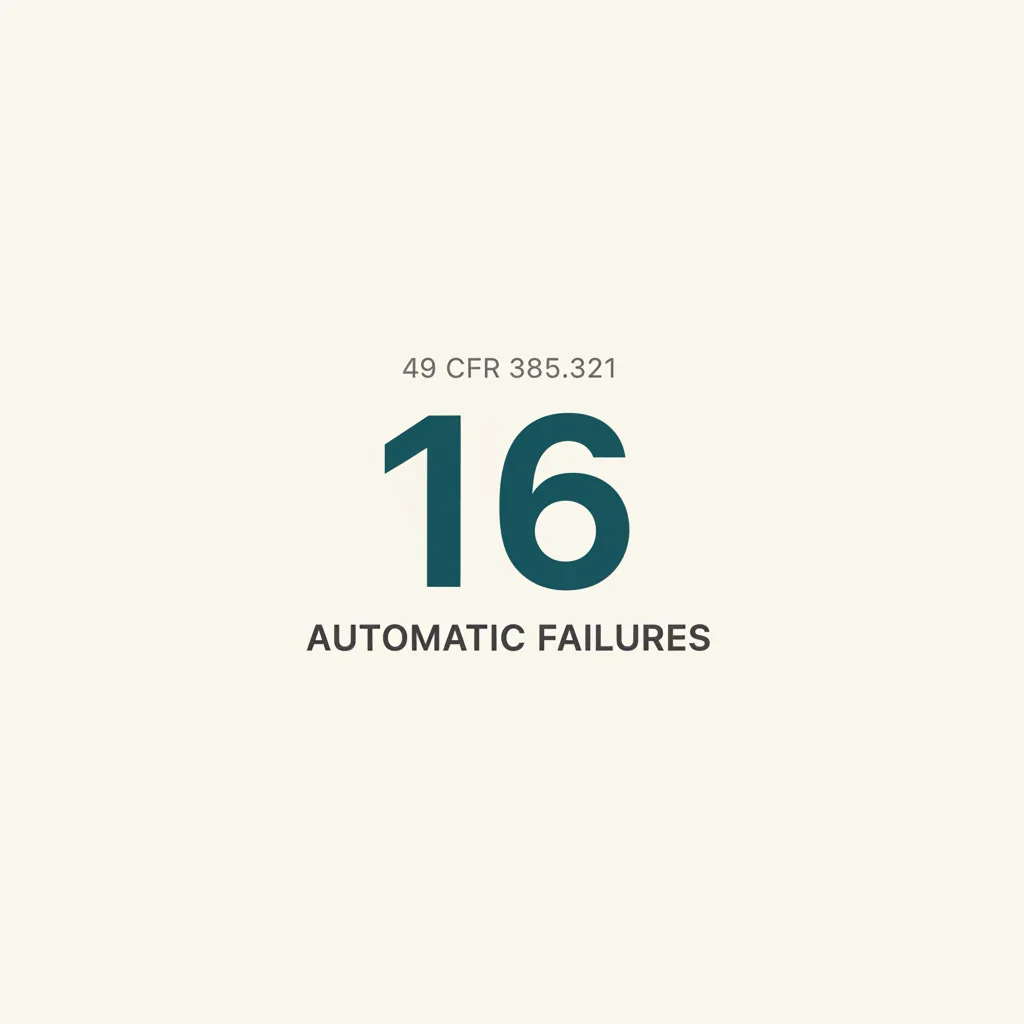
FMCSA published a final rule in December 2008 establishing sixteen regulations under §385.321 on which a new entrant safety audit fails automatically. One violation ends it, regardless of how the rest of the operation looks.
| Area | Citation | Violation |
|---|---|---|
| Drug and alcohol | §382.115(a)/(b) | No alcohol or controlled substances testing program |
| §382.201 | Using a driver with an alcohol concentration of 0.04 or greater | |
| §382.211 | Using a driver who refused a required test | |
| §382.215 | Using a driver with a positive controlled substances result | |
| §382.305 | No random testing program | |
| Licensing | §383.3(a), §383.23(a) | Knowingly using an unlicensed commercial driver |
| §383.37(b) | Allowing operation on a disqualified or invalid CDL | |
| §383.51(a) | Knowingly permitting a disqualified driver to operate | |
| Insurance | §387.7(a) | Operating without required minimum financial responsibility |
| §387.31(a) | Operating a passenger vehicle without required coverage | |
| Driver qualification | §391.11(b)(4) | Using a physically unqualified driver |
| §391.15(a) | Knowingly using a disqualified driver | |
| Hours of service | §395.8(a) | No driver duty status records, at a 51% threshold |
| Vehicle | §396.9(c)(2) | Operating a vehicle declared out of service |
| §396.11(a)(3) | Failing to correct reported defects before operation | |
| §396.17(a) | Using an uninspected commercial vehicle, at a 51% threshold |
Read that list against the DQ file section above and something useful falls out. An incomplete driver qualification file is not on it. Missing an annual review note or a road test certificate will generate a finding, but it will not fail the audit by itself.
What does fail the audit is §391.11(b)(4) and §391.15(a): using a driver who is medically unqualified or disqualified. Those are precisely the two conditions the DQ file exists to detect. The file is not the requirement. It is the evidence that you checked, and the check is the requirement.
Carriers who treat DQ files as a filing exercise tend to have complete-looking files assembled after the fact. Carriers who treat them as a control tend to have files with gaps and a documented reason for each one, which is the stronger position.
A Checklist You Can Print
The download consolidates all six systems into a single working checklist: the eight §391.51 components as a per-driver grid, the §391.23 investigation log with attempt-tracking columns and a terminal disposition field, the three Clearinghouse obligations with due-date columns, the Part 396 retention schedule, the accident register fields, and the sixteen automatic-failure items as a pre-audit sweep.
Download the DOT compliance checklist (.docx)
What Superunit Handles
Superunit does not sell compliance software and does not manage your files. We do one part of this checklist: the §391.23 previous-employer investigation, which is the piece that depends on someone else answering.
Our AI agents do what a verification coordinator would otherwise do by hand. They call the previous employer, work the phone tree, hold, send and re-send by email and fax, read what comes back including returned PDFs, and keep working the request until they get an answer or the channel is genuinely exhausted.
On a DOT file the agents collect the record sets the qualification file needs: employment verification, the three-year accident history under §391.23, and drug and alcohol history where a previous-employer inquiry still applies. For CDL drivers under FMCSA that last one comes from the Clearinghouse rather than from previous employers. For safety-sensitive positions under other DOT modes, PHMSA-regulated pipeline and hazardous materials work among them, the inquiry under 49 CFR Part 40.25 still applies.
What comes back is captured as a structured result and published into your system with the source document attached, along with the attempt log: every channel tried, every date, and a terminal disposition for each request. Nobody on your side retypes anything. Superunit has completed more than 200,000 verifications across employment, income, and DOT files.
If you are comparing tools rather than services, our review of the best DOT employment verification software for FMCSA compliance covers the field, and what FMCSA audit reviewers look for goes into how these records get interrogated in practice.
Frequently Asked Questions
What is required for DOT compliance? Six record systems: driver qualification files under Part 391, a drug and alcohol testing program with Clearinghouse queries under Part 382, hours-of-service records under Part 395, vehicle maintenance and inspection files under Part 396, an accident register under §390.15, and current operating authority and insurance under Parts 387 and 390.
What goes in a driver qualification file? Eight components under §391.51(b): the employment application, MVRs from each state where the driver held a license in the past three years, the road test certificate or accepted equivalent, the annual MVR, the annual review note, the medical examiner's certificate, any medical variance, and a National Registry verification note. The §391.23 safety performance history investigation is separately required and is retained under §391.53.
How long do you keep a driver qualification file? For as long as the driver is employed, plus three years after separation, under §391.51(c). Annual MVRs, annual review notes, medical certificates, variances, and registry verification notes may be purged three years after execution under §391.51(d).
What fails a DOT audit automatically? Sixteen violations under §385.321 fail a new entrant safety audit outright, covering drug and alcohol program failures, unlicensed or disqualified drivers, missing insurance, medically unqualified drivers, absent duty status records, and out-of-service or uninspected vehicles. A single violation is enough.
When does a new carrier get audited? Interstate new entrants are generally audited within the first 12 months of receiving operating authority. The safety audit is pass/fail and separate from a compliance review, which is triggered by crash history, roadside inspection data, complaints, or CSA scores.
What is the random drug testing rate for 2026? 50% for controlled substances and 10% for alcohol, unchanged since 2020. Both are annualized minimums against your average number of driver positions, and selections must be spread across the year.
Do we have to run an annual Clearinghouse query? Yes. Every employer subject to Part 382 must query the Clearinghouse once a year for every current CDL driver. The annual query may be a limited query, but if it indicates a record exists, §382.701(b)(3) requires a full query within 24 hours.
What if a previous employer never responds to a §391.23 request? Non-response is not a violation on its own. Undocumented non-response is. Keep the request, evidence of delivery, a log of every follow-up with date and channel, and a terminal disposition for each entry — responded, no record returned, refused, defunct, or non-responsive after documented good-faith effort.
The Checklist Is a Control, Not a Binder
The carriers who do well in review are not the ones with the tidiest binders. They are the ones who can show that each check happened, when it happened, and what they did when it came back empty.
That distinction matters most in the one system that depends on an outside party answering. Every other item on this checklist is something you can complete on your own schedule. The §391.23 investigation is not, and it is the item most likely to be sitting incomplete when a reviewer asks.
If chasing previous employers is eating your safety department every hiring cycle, see how Superunit handles DOT verification outreach.