TL;DR
- Ontellus ranks #1 for enterprise carriers already running Guidewire or Duck Creek, where its core-system integrations remove duplicate data entry across records retrieval and canvassing.
- Superunit ranks #2 because its AI agents contact facilities simultaneously without a headcount ceiling, which is what high-volume teams need when results are due in 48 hours.
- CDI Canvassing ranks #3 as the pure-play specialist, with a published 3-day average turnaround and canvassing-only focus instead of a bundled investigation suite.
- Ethos, Delta Group, Alpine Intel, and Magna round out the list, each strongest when canvassing feeds a larger investigation or litigation program.
- AI-powered canvassing changes the math once your volume outpaces what a human team can clear inside your SLA.
Why Medical Canvassing Vendor Selection Matters More Than It Used To
A medical canvass that comes back slow or incomplete costs more than the canvass itself. When a canvasser misses a claimant's prior treatment for the same body part, the adjuster sets reserves blind and loses the leverage that early evidence of a preexisting condition would have provided. A canvass that lands two weeks late often lands after the reserve decision is already made, which makes the result documentation rather than intelligence. The value of a canvass is highest before money is committed, and it decays fast.
The vendor field has split into two models, and that split changes what you should evaluate. Human-only firms staff canvassers who call facilities one at a time, and their throughput is capped by headcount and working hours. AI-augmented providers run agents that contact multiple facilities at once, so volume scales without hiring. That difference matters most on the criteria buyers used to take for granted, namely turnaround speed, cost per canvas, and documentation consistency. The list below weighs all seven vendors against the same criteria, and it treats missing public data on pricing or SLA as a weakness rather than a neutral blank.
If you're new to the topic: a canvass is narrow phone outreach that confirms whether and when a claimant was treated at a facility, with no PHI and no signed release. The full walkthrough of triggers, canvass types, and compliance lives in our medical canvassing guide — this page assumes you're past that and choosing a vendor.
What to Look for in a Medical Canvassing Company
Before you read the vendor entries, fix the criteria you'll judge them against. Seven dimensions separate a canvassing firm that closes a claim from one that adds two weeks of delay and a thin report.

National coverage breadth. A canvasser who can reach facilities in every state matters when a claimant treats across jurisdictions or relocates mid-claim. Most established firms claim nationwide reach, but confirm whether that means direct outreach everywhere or subcontracted coverage in thinner markets.
Turnaround SLA. Ask for a published average and a guaranteed ceiling. A canvass that lands in three days lets you set reserves while the file is still fresh. One that takes three weeks arrives after the adjuster has already moved. Many vendors quote no SLA at all, which should lower your confidence rather than stay neutral.
Technology stack: human or AI. Human-only firms cap throughput at headcount and working hours. AI-powered outreach contacts facilities simultaneously across time zones, so volume scales without hiring. The trade-off shows up in relationship-based access and complex escalation, where experienced human canvassers still hold an edge.
Lines of business supported. Workers' comp, auto bodily injury, and disability each carry different facility types and red flags. Pharmacy and specialty canvasses, which Ontellus offers, are not universal. Match the vendor's coverage to the claim types your team actually runs.
HIPAA compliance posture. Demand a signed Business Associate Agreement before any vendor touches a name and date of birth. SOC 2 Type II certification signals a vendor that audits its own controls. The penalty exposure is concrete, with HIPAA Privacy Rule violations running from $145 to $73,011 per incident, and a self-insured employer stays the risk-holder even when a TPA administers the plan.
Reporting format and audit trail. A defensible canvass produces call recordings, transcripts, timestamps, and the outreach method used. AI systems generate that record automatically. Human documentation varies by canvasser, so ask to see a sample report.
Cost structure. Per-canvas pricing, often quoted in batches of ten, runs roughly $10 to $15 per facility at human-only firms. Subscription and volume-tiered models change the math for TPAs ordering hundreds of files. Vendors that hide pricing entirely make budgeting harder.
The 7 Best Medical Canvassing Companies for 2026
We ranked these seven vendors on coverage, turnaround, technology, lines of business, HIPAA posture, reporting, and cost. The order reflects who serves the most buyers well, not who shouts loudest. Read each entry for the gap as much as the strength.
1. Ontellus — Best for Enterprise Carriers on Guidewire or Duck Creek
Ontellus earns the top slot for one concrete reason. It is a premium partner of both Guidewire and Duck Creek, and it has built integrations into both core systems. For an enterprise carrier already running claims on one of those platforms, that matters more than any feature on a canvassing data sheet. Canvass requests and results move inside the system your adjusters already work in, instead of through email attachments and a separate vendor portal. No other vendor on this list comes close on that front.
The service breadth backs up the ranking. Ontellus runs medical canvasses to verify injury dates, treatment plans, and prior claims history, but it also offers pharmacy canvasses that surface drug-seeking patterns and interaction risks across prescribers, plus specialty canvasses that confirm or refute mobility and athletic claims. Pharmacy canvassing in particular is a genuine differentiator, since several competitors stop at medical providers. The social media side runs on a proprietary tool, OPTI Check, for court-admissible investigations. Coverage is nationwide across workers' comp, auto bodily injury, and disability.
On compliance, Ontellus clears the bar enterprise buyers care about. It is HIPAA compliant and holds SOC 2 Type II, which is the audit standard a carrier's security review will ask about by name. That matters when you are placing claimant-adjacent data with a third party and need to defend the choice internally.
Two honest gaps keep Ontellus from being the obvious pick for every buyer. First, the company publishes no turnaround SLA. If your team is measuring vendors on guaranteed days-to-result, you will not find a committed number on the site, and you will have to extract one in the contract. Second, there is no mention of AI or automated outreach anywhere in the canvassing offering. This appears to be human-only canvassing, which carries a real ceiling on throughput and a higher cost per canvas at volume. A team running hundreds of canvasses a month will feel both.
There is also a structural point worth naming. Canvassing at Ontellus sits inside a broader records-retrieval platform rather than standing on its own as a dedicated product. For an enterprise carrier that wants one vendor for records and canvassing together, that consolidation is the selling point. For a buyer who wants a canvassing specialist with a published benchmark and transparent pricing, it reads as a secondary service line.
Choose Ontellus if you are an enterprise carrier or TPA on Guidewire or Duck Creek and you value a single vendor and a clean integration over speed and cost-per-canvas. If those last two drive your decision, keep reading.
2. Superunit — Best for High-Volume Teams That Need Fast Turnaround
Superunit runs canvassing through AI agents that call facilities in parallel, which means a single 15-facility order and 1,000 simultaneous 60-facility orders complete at the same speed. Average turnaround holds at 24 hours regardless of volume. A human team of canvassers cannot make that claim, because every call still occupies a person for a block of time and the queue lengthens as orders stack up.
The cost difference follows from how each model scales. Human canvassing is a staffing cost that grows roughly in step with volume. Each new batch demands canvasser hours, and hitting a 48-hour deadline on a spike means hiring and training ahead of demand. Superunit carries none of that. There is no headcount to add, no onboarding, no turnover, no holidays, and no time-zone gaps, so the marginal cost of the next canvas stays low even as monthly volume climbs into the thousands.
Documentation is consistent because the same outreach script runs on every call, and each canvas produces a complete record automatically. You get the call recording, transcript, timestamp, and outreach method on every facility, without depending on how thorough an individual canvasser felt that day. For SIU files headed toward litigation, that audit trail matters as much as the result itself.
Two honest limitations. Some carrier and TPA master service agreements now include clauses restricting AI in canvassing, driven by data-privacy concerns rather than doubts about whether it works. If your MSA carries that language, an AI provider is off the table until the contract is renegotiated. Human firms also hold an edge on the hardest cases, where a canvasser's existing relationship with a facility's records office, or judgment about when to escalate a stonewalling clinic, opens a door that a scripted call cannot.
Superunit fits best when you run volume and need predictable speed. High-frequency SIU programs, TPAs managing hundreds of open files, and seasonal spikes are where the model pays off, because that is exactly where human staffing hits its ceiling.
3. CDI Canvassing — Best Pure-Play Specialist
CDI Canvassing builds its entire pitch on one number: a 3-day average turnaround, against a stated competitor range of 5 to 7 days. That claim, published on cdicanvassing.com, works out to a roughly 40% reduction in cycle time, and it is the differentiator the firm leads with everywhere. For a buyer whose pain is slow reserve decisions and stale canvass data, a vendor that anchors on speed deserves a look.
The firm refuses to bundle. CDI markets itself as a pure-play canvassing company and argues that unbundled canvassing produces cleaner outcomes than the same work tucked inside a larger investigation program. A quoted carrier claims director on the site calls it "the only true medical canvassing company in the industry," which is marketing language, but the strategic point holds. If you want a vendor whose only job is canvassing, CDI fits that brief better than the full-service firms on this list.
CDI also positions as the cost leader in medical canvassing and credits proprietary technology investment for the lower price. The company describes its platform as "tech-enabled" with process automation and an "Advanced Tech Platform," and it offers bulk ordering through a dedicated workflow. For a TPA or SIU unit running canvasses in volume, that combination of low per-canvas cost and batch ordering is the right shape.
On lines of business, CDI covers workers' compensation, auto and general liability bodily injury, litigation, and both short- and long-term disability. The firm targets the claim types where undisclosed treatment tends to hide, including soft tissue and spinal injuries, fractures, head injuries, whiplash, carpal tunnel, and psychological claims. Reports are described as HIPAA-compliant, and the client roster spans carriers, TPAs, SIU units, and adjusters.
The honest gaps are about disclosure. CDI publishes no pricing, even with a dedicated pricing page that routes you to a contact form for individual and bulk quotes. The "Advanced Tech Platform" is named but never explained, so there is no way to know whether the automation involves AI-driven outreach or simple workflow tooling. No state coverage count, SLA guarantee, or third-party validation of the 40% turnaround claim appears anywhere on the site. The speed claim is plausible, but you are taking it on the vendor's word.
4. Ethos Risk Services — Best for Bundled Medical Management
Ethos Risk Services makes sense when you want canvassing to feed directly into the same vendor's downstream work. Canvassing sits inside its Medical Management division alongside Case Management, IME, Utilization Management, and Medical Bill Review (service page). When a positive hit needs to escalate into surveillance, an independent medical exam, or an SIU referral, you keep the file with one team rather than handing it across vendors.
The canvassing itself is human-executed and reaches an unusually wide set of provider categories. Beyond hospitals and doctors' offices, Ethos investigators contact chiropractors, pain management clinics, mail-order pharmacies, podiatrists, fitness centers, and cash-based practices that never show up in major medical databases (blog). That breadth matters on soft-tissue and hard-to-diagnose claims where prior treatment hides in small facilities. Investigators start nearest the claimant's current and prior addresses, then widen the radius.
You also get daily progress updates rather than a single report at the end, and Ethos says it responds to new case submissions "within hours, not days," with most cases closing inside a week (service page). For an adjuster trying to time a reserve decision, the running visibility is genuinely useful.
Ethos credits a proprietary "Universal Database" as the backbone of its research and describes it as leaving "no stone unturned." No specifications back the claim. The company publishes nothing about the database's record count, geographic coverage, or how it sources its data, so you have to take the strength of the asset on faith.
The honest weakness is the absence of a guaranteed SLA. "Most cases completed within a week" is a soft benchmark, not a commitment, and for a TPA holding hundreds of open files, a soft benchmark is hard to plan around. Pricing is not published either, and the site discloses no API or case management integration details. Ethos is the right call when the bundled escalation path and provider-category depth outweigh your need for a firm turnaround number.
5. Delta Group — Best for Full-Service SIU Programs
Delta Group fits the SIU team that treats canvassing as one piece of a wider investigation program rather than a service it buys on its own. The company calls itself "the largest privately held firm" in insurance investigations and serves national carriers, TPAs, self-insured entities, captives, and public bodies across both field and desktop work (deltagroup.net). If you already send Delta surveillance, social media analysis, and background checks, adding canvassing to the same referral keeps everything under one roof.
CaseTracker, their proprietary case management tool, is the practical reason this consolidation works. It tracks a referral from intake through resolution, so an adjuster managing several investigation types on one claim sees them in a single workflow instead of chasing separate vendors. For a multi-claim fraud matter, that coordination matters more than any single canvass.
Be clear-eyed about what Delta does not publish. Medical canvassing sits inside their Desktop Investigations line alongside background checks, and it is not broken out as a dedicated service (deltagroup.net). The homepage gives no methodology, no outreach process, no reporting format, and no HIPAA posture for canvassing specifically. One client testimonial praises a canvass as "one of the best I have seen," which speaks to quality but tells you nothing about turnaround or process (deltagroup.net).
Pricing and SLA are equally opaque. Delta publishes no per-canvas rate, and a testimonial that calls them "worth the cost" signals a premium position without a number behind it (deltagroup.net). Nothing in their material confirms AI-assisted outreach. Choose Delta when bundled field-and-desktop investigation is the goal and canvassing volume is modest. If canvassing is your primary spend, a specialist will give you firmer commitments.
6. Alpine Intel — Best for Multi-Service Escalation Paths
Alpine Intel earns this slot for a narrow reason. If your canvasses regularly turn up something worth chasing, Alpine lets you hand the case to the same vendor for surveillance, social media investigation, or a background check. It files medical canvassing under its Investigative Intelligence line and treats the canvass as the first step in a longer inquiry, with explicit downstream paths when results warrant a closer look. For an SIU team that wants one investigative partner across the full escalation, that continuity has real value.
The canvassing work itself covers the standard ground and one detail worth noting. Alpine's canvassers contact providers, hospitals, urgent care, and specialty clinics to confirm treatment locations, injury dates, prior treatment, and claims history. The pharmacy piece stands out. Alpine runs pharmacy checks within a radius of the claimant's residence or stated injury location, confirming prescribed medications, prescription dates, and pickup. That radius approach helps when a claimant's account of their treatment timeline doesn't hold together.
Alpine states plainly that all canvassing stays inside HIPAA by contacting providers only for non-protected details that need no patient authorization or medical release. The service supports workers' comp, auto, property, litigation, and SIU claims, so the lines-of-business breadth is solid.
The gaps are real, and they matter for a buyer comparing options. Alpine discloses no proprietary technology, no automation, and no AI in any of its canvassing material, describing the work in purely human terms. It also publishes no turnaround SLA, no geographic coverage figures, and no pricing. You are buying a competent human canvassing operation with strong escalation paths, not a vendor that competes on speed or cost transparency.
7. Magna Legal Services — Best for Litigation-Facing Canvassing
Magna packages canvassing as one piece of a three-part investigation that runs straight into litigation prep, which is what sets it apart from the specialists on this list. Its Medical Canvassing Investigation bundles a social media and online search, the canvass itself, and records retrieval into a single engagement. Investigators use proprietary databases to identify treating facilities, contact each one, and then hand findings to a records retrieval team that can prepare and serve subpoenas and act as deposition officer.
That records retrieval depth is the genuine differentiator. Most canvassing firms confirm where a claimant was treated and stop there. Magna takes the same facility list and starts the legal process of pulling those records, which matters when a claim is already heading toward deposition or trial. For an SIU team building a litigation file, having canvassing and subpoena work under one roof removes a handoff between vendors.
The investigation runs HIPAA compliant and is staffed by licensed investigators, with published investigations licenses in California and Texas. Magna names insurance adjusters and legal professionals as its audience and frames the work around confirming treatment relative to a loss date, surfacing pre-existing conditions, and exposing misrepresentation.
The weaknesses are real. Magna publishes no turnaround SLA, so you cannot predict delivery before you order. It treats canvassing as a general insurance and litigation tool rather than a workers' comp specialty, and there is no distinct comp framing on the page. Pricing is consultation-only, with no per-canvas fee or volume structure disclosed. If your driver is speed or cost per canvas, look elsewhere.
How AI-Powered Canvassing Differs from Traditional Human Canvassing
The structural difference between human and AI canvassing comes down to how each model handles volume. A human team is capped by headcount and working hours. Dedicated canvassers still hit a wall when a client needs results across hundreds of facilities in 48 hours, because each caller can only work one phone line at a time. AI agents contact facilities simultaneously regardless of time zone or batch size, so volume scales with demand instead of with hiring.
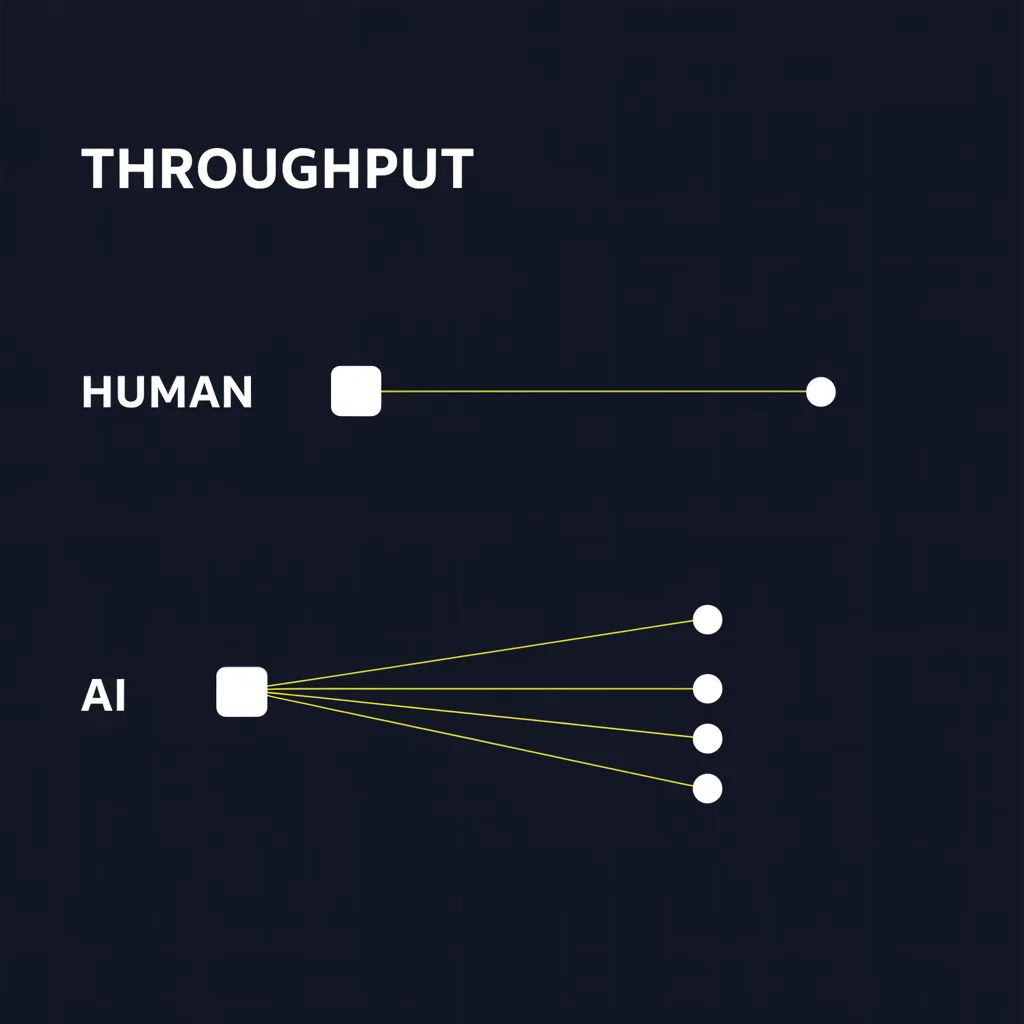
Cost moves with that same throughput dynamic. Human canvassing at established firms runs roughly $10 to $15 per facility, usually ordered in batches of ten, and that price reflects the labor underneath it. AI-powered canvassing carries a lower marginal cost once volume builds, though build-versus-buy economics vary enough that the headline price tells you less than your actual order pattern does.
Documentation consistency is where AI has a clear structural edge. Every call runs the same prompt, and the system produces recordings, transcripts, timestamps, and the outreach method automatically. Human canvassers vary in how thoroughly they note an interaction, so audit-trail quality depends on the individual and on the day. For SIU files that may end up in litigation, a uniform record matters more than most buyers weigh it.
The objections to AI canvassing are real and worth naming. Facilities sometimes recognize an automated call and hang up, and phone trees demand purpose-built navigation rather than a generic dialer. The larger barrier is contractual. Carrier and TPA master service agreements increasingly include AI restriction clauses, and the driver is data privacy rather than doubt about whether the technology works. The concern is that personally identifiable information could be used to train a model or exposed in a breach.
Vendors that design around that concern are better positioned to operate inside those MSAs. A canvass needs very little to confirm a visit. Collecting only name and date of birth, then segregating that data so it never touches a training pipeline, addresses the privacy objection directly rather than asking carriers to take it on faith. Adoption in SIU workflows is still early, so the providers proving out least-privilege data handling now will set the terms by which the rest of the category gets evaluated.
TPA and High-Volume Buyer Considerations
A TPA managing several hundred open files at once buys canvassing differently than a single-carrier SIU team running a handful of suspicious claims. The difference comes down to throughput, integration, and exposure, and each one changes which vendor actually fits.
Batch ordering is the first dividing line. CDI offers a dedicated bulk orders path, and most established firms accept batches of ten or more, but human-only operations hit a throughput wall when a TPA submits two hundred canvasses in a week and expects results inside the same SLA window. AI-powered outreach removes that ceiling because facility contacts run in parallel, so a batch of two hundred moves at roughly the same speed as a batch of twenty.
Case management integration matters more at volume because manual data entry across hundreds of files becomes its own bottleneck. A vendor that pushes results back into your claims platform saves the adjuster the step of rekeying findings, which is trivial on ten files and crippling on three hundred.
BAA requirements carry real teeth here. Self-insured group health plans are covered entities under HIPAA whether or not a TPA administers them, and the employer stays the risk-holder even when the TPA handles administration (fisherphillips.com). Privacy Rule penalties run from $145 to $73,011 per violation, up to $2,190,294 per calendar year at the lowest culpability tier. Every canvassing vendor touching plan data needs an executed BAA, no exceptions.
Volume pricing tiers and turnaround SLA become the two terms a TPA should negotiate hardest. A one-day swing in turnaround is a rounding error on a single file. Across three hundred open claims feeding reserve decisions, that same swing delays settlement and ties up capital, which is why the SLA outranks the per-canvas rate at scale.
Specialist Canvassing Firm vs. Full-Service Investigation Firm: How to Choose
Three questions decide whether a canvassing specialist or a bundled investigation firm fits your program better. Answer them honestly before you compare vendor features, because the right structure matters more than the marginal differences between any two providers.
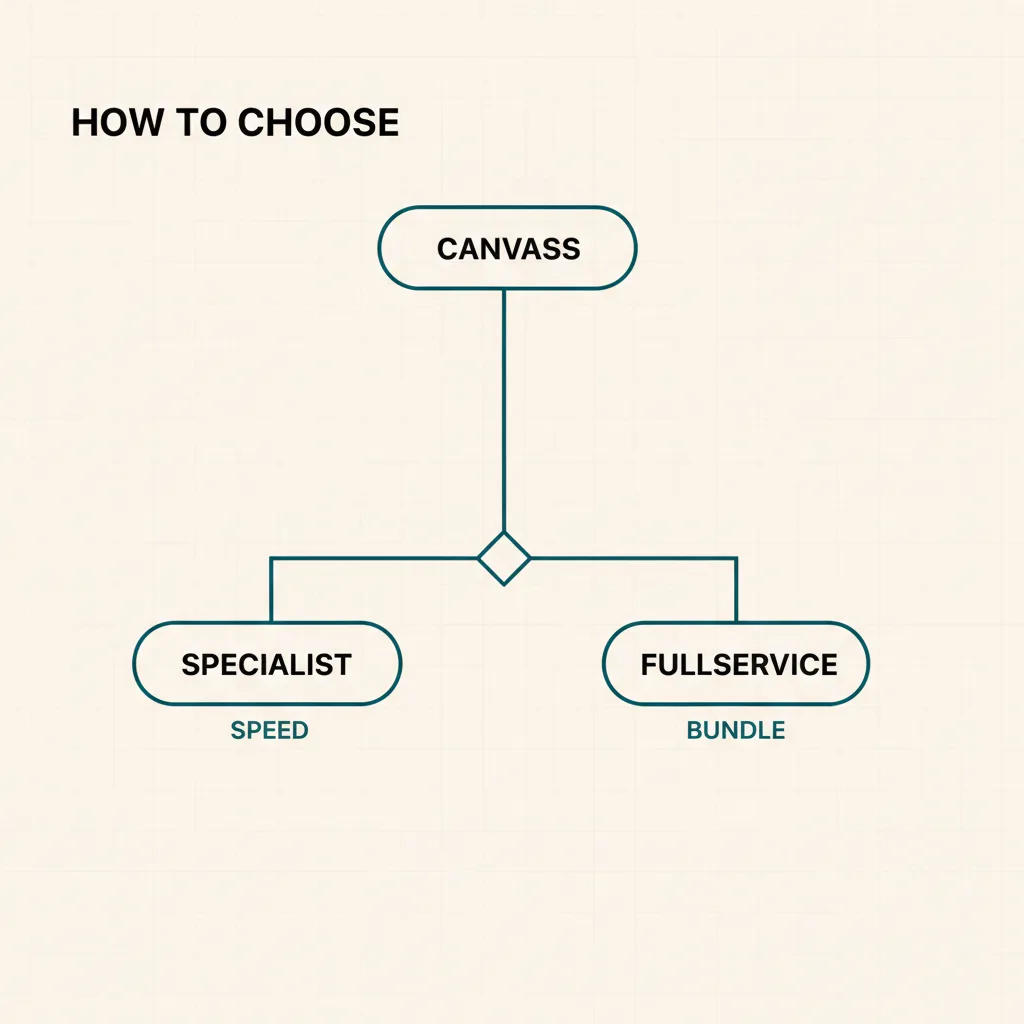
Start with canvassing volume relative to total investigation spend. If canvassing is your dominant line item and you order hundreds of files a month, a specialist like CDI or an AI-driven provider like Superunit gives you better cost per canvas and faster turnaround than a firm that treats canvassing as one item inside a desktop bundle. When canvassing is occasional and surveillance or IME work dominates your budget, the specialist's pricing edge stops mattering and consolidation wins.
Next, ask whether downstream services need coordination. A canvass that flags undisclosed treatment often triggers records retrieval, an IME, or surveillance. Delta Group and Ethos Risk Services can run that handoff inside one case file with one point of contact, which removes the friction of re-briefing a second vendor and re-establishing chain of custody. If your canvasses rarely escalate, that coordination buys you nothing and you pay a premium for capacity you don't use.
Finally, decide whether turnaround or relationship continuity is your binding constraint. Specialists compete on speed, and CDI publishes a 3-day average against a stated 5 to 7 days elsewhere. Full-service firms compete on continuity, where a six-year relationship and a single adjuster contact reduce the cost of managing the work. A high-volume TPA juggling open reserves usually needs speed. A smaller SIU team running complex fraud cases often values the continuity more.
Match the answers, not the brand. A program that wants speed and low unit cost should not buy a bundle it never escalates.
Vendor Comparison Table
The seven vendors split cleanly along one axis. Ontellus and Superunit publish the most, while the bundled investigation firms disclose the least about canvassing specifically.
| Vendor | Best For | Coverage | Turnaround SLA | AI/Automation | Lines of Business | HIPAA Noted | Pricing Transparency |
|---|---|---|---|---|---|---|---|
| Ontellus | Guidewire/Duck Creek carriers | Nationwide | Not disclosed | No | WC, Auto BI, Disability | Yes (SOC 2 Type II) | Not disclosed |
| Superunit | High-volume, fast turnaround | Nationwide | Fast (AI throughput) | Yes (AI outreach) | WC, Auto BI, Disability | Yes | Per-canvas, volume |
| CDI Canvassing | Pure-play specialist | National (implied) | 3-day average | Tech-enabled, unspecified | WC, Auto/GL BI, LTD/STD, litigation | Yes | Not disclosed |
| Ethos Risk | Bundled medical management | National | "Most within a week" | No | WC, Auto, GL, Disability, Life | Yes | Not disclosed |
| Delta Group | Full-service SIU | Nationwide | Not disclosed | No (canvassing) | WC, GL, LTC | Not disclosed | Not disclosed |
| Alpine Intel | Multi-service escalation | National | Not disclosed | No | Property, Auto, WC, SIU, litigation | Yes | Not disclosed |
| Magna Legal | Litigation-facing | CA, TX licensed | Not disclosed | No | Insurance, civil litigation | Yes | Not disclosed |
Why Ontellus Holds the Top Spot — and When to Look Past It
Ontellus earns the top spot for one concrete reason most competitors can't match. Its integrations with Guidewire and Duck Creek let enterprise carriers pull canvassing results into the same core systems that run their claims. If your adjusters already work inside one of those platforms, a single vendor handling records retrieval, canvassing, and social media investigation saves real coordination cost. SOC 2 Type II and the pharmacy canvassing line widen the lead.
Those advantages stop mattering when speed and cost per canvas drive the decision. Ontellus publishes no turnaround SLA and runs human-only outreach, which means throughput is capped by headcount. A TPA pushing hundreds of files through 48-hour windows hits that ceiling fast. In that scenario, Superunit's AI agents contact facilities in parallel without a hiring constraint, and CDI's published 3-day average gives a specialist benchmark Ontellus doesn't offer.
Pick Ontellus when platform integration and service breadth outweigh turnaround. Choose Superunit when volume and cost per canvas are the binding constraints, and CDI when you want a canvassing-only specialist with a stated turnaround number.
How We Evaluated These Medical Canvassing Companies
We ranked these seven vendors against the same seven criteria every section above applies: national coverage breadth, turnaround SLA, technology stack, lines of business supported, HIPAA compliance posture, reporting format and audit trail, and cost structure. Each criterion carried equal weight, and we scored vendors on what they publish and what their service model can actually deliver, not on marketing language.
No vendor paid for placement, and none reviewed or approved its entry before publication. We have no referral relationship with any company on this list.
Where a vendor declined to publish pricing, an SLA, or its technology details, we treated that absence as a weakness rather than a neutral unknown. A buyer evaluating two firms cannot compare a 3-day turnaround claim against silence and call them equal. Vendors that disclose more earn more trust, and the ranking reflects that. Superunit appears at #2 by the same standard, and we name where human-only firms still outperform it.
Frequently Asked Questions
What does a medical canvass report include? A canvass report lists every facility contacted, whether the claimant was confirmed as a patient, and the outreach method, timestamps, and call records behind each result. With Superunit, the report ships with complete transcripts and recordings attached to each contact, so your claims team gets an audit trail rather than a summary. That documentation lets adjusters move straight from positive hits to signed authorizations and full records retrieval.
How long does a canvass take? Human-only firms typically return results within a week, with daily progress updates along the way. Superunit's AI agents contact facilities simultaneously, which compresses turnaround to hours on most batches regardless of volume. Faster confirmation means you can set reserves and trigger SIU referrals before the file ages.
Is medical canvassing HIPAA compliant? Canvassing stays compliant because canvassers ask only whether a visit occurred, never diagnoses or treatment details. Superunit limits collection to name and date of birth and segregates that data, which keeps PII exposure minimal under your business associate agreement. Lower data exposure reduces your breach risk and the HIPAA penalty exposure that reaches up to $73,011 per violation.
What is the typical cost per canvas? Human canvassing at established firms runs roughly $10 to $15 per facility, usually ordered in batches of ten. Superunit's marginal cost drops sharply at scale because no headcount sits behind each call. High-volume teams see the largest savings on cost per canvas.
When should a TPA order a canvass vs. wait for records? Order a canvass first when prior treatment is unclear, witness accounts conflict, or the claim history looks suspicious. Superunit's fast turnaround makes early canvassing practical even across hundreds of open files. Confirming treatment locations early shortens the records-retrieval cycle that follows.