
TL;DR
Most reference check tools send a form and wait. Superunit runs AI agents that reach references by text, phone, and email at the same time, hitting roughly 85% completion in about three hours, for under $5 per completed reference. Superunit only bills when a reference actually completes, so a non-response costs nothing.
- Superunit — multi-channel AI outreach, ~85% completion, ~3hr turnaround, sub-$5 per reference. Built for volume and speed.
- Xref, Refapp, Harver/Checkster — survey-based platforms where references complete online questionnaires, with deep ATS integration and curated templates.
- Checkr — reference checks sold as an add-on inside its background-screening platform, not a standalone product.
- Discovered.ai — the category incumbent most buyers already know by name.
Why reference checking still bottlenecks hiring
A single reference call can eat 30 minutes to an hour, and hiring managers usually chase three references across three or four days before they get a usable answer, according to a 2008 SHRM analysis of the manual process. Phone tag drags it out further, and the answers you do get vary wildly depending on who picked up and what mood they were in.
Much of the software sold as reference check automation solved the wrong half of that problem. Xref, Refapp, and Harver's Checkster, the vendors documented in this comparison, replaced the phone call with a survey link, then waited for the referee to open an email and fill out a form. The chasing didn't disappear. It just moved from the recruiter to an inbox where nobody feels urgency.

This divide between automated outreach and automated forms runs through the whole comparison. On one side sit the form-based platforms, Xref, Refapp, and Harver's Checkster, which email a questionnaire and hope for a response. Checkr bundles references into a broader background-screening product. Discovered.ai positions itself as a category incumbent. On the other side, Superunit runs live outreach across text, phone, and email at once. Whether a vendor automates the outreach or only the form determines its completion rate and turnaround, and most of what a buyer actually pays for.
Snapshot comparison table
This table compares each vendor across the five factors that decide a reference-check purchase. Hard numbers appear only where a vendor or independent source publishes them. Everything else stays qualitative rather than invented.
| Vendor | Channels | Turnaround | Completion rate | Question customization | Pricing model | Best for |
|---|---|---|---|---|---|---|
| Superunit | AI agents via text, phone, and email simultaneously | ~3 hours avg | ~85% | Fully customizable | Under $5 per reference | Speed and completion at volume with predictable per-reference cost |
| Xref | Form-based survey, SMS prompts | ~18 hours (Xref reference checking solution) | Not published | Curated templates plus custom | Custom quote | Dedicated survey platform with fast deployment |
| Refapp | Form-based, optional live-call scheduling | 1–2 days, often same day (Refapp product site) | Not published | Role-specific templates, standardized-question compliance angle | Usage-based, demo required | Digital automation with optional live-call workflows |
| Harver/Checkster | Candidate-initiated online survey | Vendor claims 24 hours (Virvell reference software comparison) | Not published | Job-category templates | Custom per-check | High-volume hiring needing fraud detection |
| Checkr | Sold as an add-on to background screening; mechanism not documented | Not published for references | Not published | Not documented | Tiered, enterprise custom above 300/year | Teams already inside Checkr's screening ecosystem |
| Discovered.ai | Not independently confirmed | Not published | Not published | Not confirmed | No public pricing | Category incumbent buyers already evaluating it |
How we evaluated these tools
We scored each vendor on five factors: channels, turnaround time, completion rate, question customization, and pricing model. Channel mix carries the most weight because it drives the other four. A tool that reaches referees by phone, text, and email closes faster and completes more references than one that waits on a survey link, and it does both without the buyer changing anything.
The figures come from two places. Where a vendor publishes a hard number, like Xref's 18-hour average, we cite it directly. Where a vendor claims a figure without independent confirmation, we say so. Where nothing is published, the table reads "not published" rather than a number we invented.
Channels: Superunit's phone, text, and email vs. forms-only surveys
The channel a tool uses to reach a referee sets the ceiling on how fast and how often you get answers back. Every reference check comes down to reaching a busy person and getting them to respond, and a survey link is one of the easier things to ignore in an inbox.
Xref, Refapp, and Harver's Checkster all run on the same core mechanism. The referee receives a link and completes a written questionnaire online whenever they get around to it. Xref explicitly frames its product as an alternative to live conversation, answering the question of how you hear tone without a phone call by substituting sentiment analysis for the call. Checkster's original design pushed the outreach onto the candidate, who forwards the survey to references to fill out. All three depend on the referee choosing to open a form.
A few vendors have added a second channel onto that form model. RecruitersLineUp notes that Xref adds SMS prompts to nudge referees toward the survey, and that Verified First runs phone, text, and email outreach as part of a broader screening bundle. The SMS is a reminder pointing back at the same web form, not a native conversation across channels.
Superunit runs its outreach the other way around. Its AI agents contact each referee by text, phone, and email at the same time, and they hold the conversation on whichever channel the referee answers first. A referee who never opens email might pick up a call or reply to a text, and the agent completes the check there. That simultaneous contact is what pushes Superunit's completion rate to roughly 85% with a three-hour average turnaround.
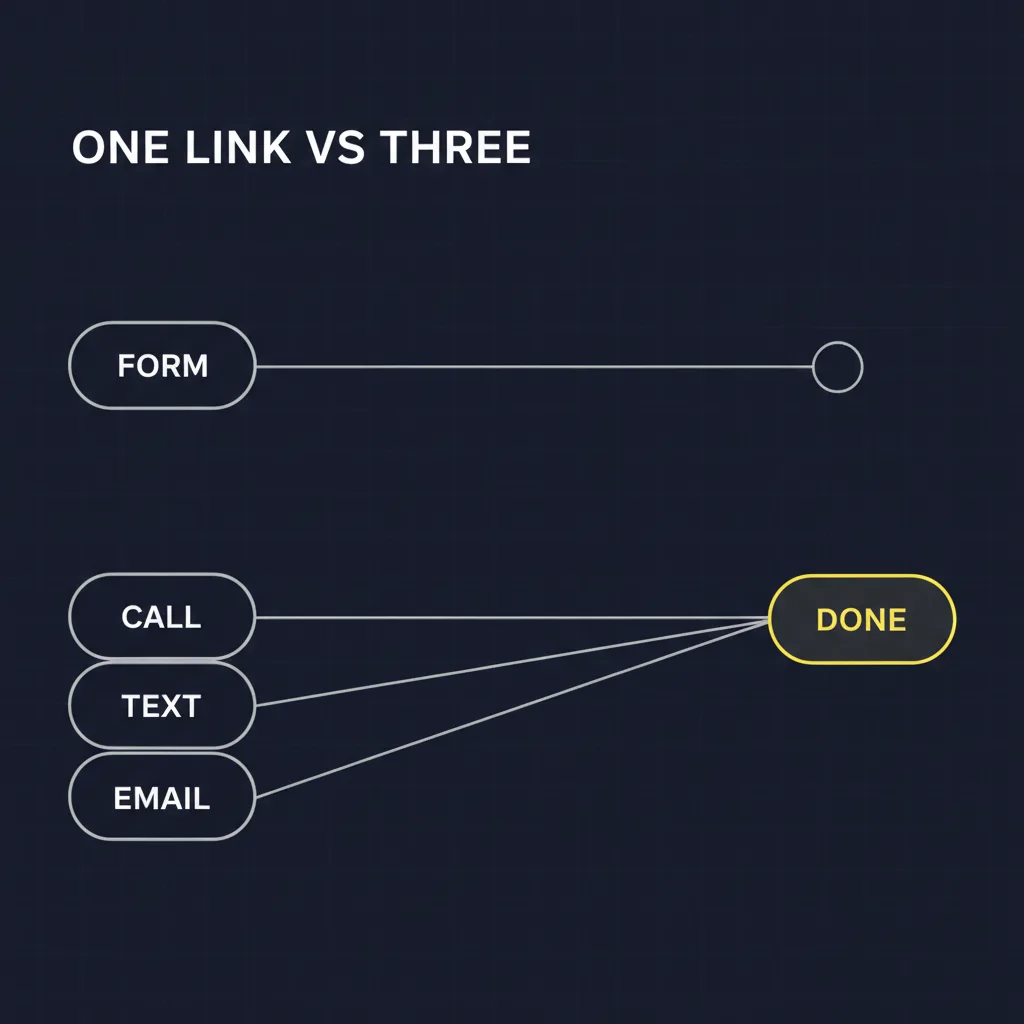
Checkr and Discovered.ai sit outside this comparison on channel detail. RecruitersLineUp's roundup describes Checkr's reference checks as an add-on to its background screening business, though Checkr's own site does not document the outreach mechanism behind that add-on. Discovered.ai holds a category-incumbent position, but it likewise publishes no channel detail to confirm or dispute.
Turnaround time: hours vs. days
Turnaround follows directly from how a vendor reaches a referee. Superunit runs AI agents that place calls, send texts, and email at the same time, which produces an average turnaround around three hours. A live conversation or a text reply happens in the moment, so the reference gets completed while the referee is still reachable rather than sitting in an inbox.
Form-based tools depend on a referee opening a survey link on their own schedule, and that delay shows up in their numbers. Xref reports results returned on average in 18 hours, using a survey the recruiter can build in about 30 seconds (Xref reference checking solution). The bottleneck is not the survey design but the wait between sending the link and the referee choosing to sit down and answer it.
Refapp shows the same pattern with softer numbers. The company states you "typically receive the completed report within a day or two, often the same day," and one customer case study claims an 80 percent cut in reference-check time after switching from a manual process (Refapp product site). A day or two beats phone tag across a week, but it still trails a workflow that reaches the referee on three channels at once.
The remaining vendors publish nothing reliable on speed. Harver and Checkster carry only a vendor-stated 24-hour claim with no independent confirmation (Virvell reference software comparison). Discovered.ai, Checkr, RefAssured, and RefNow have no independently published turnaround figure, so treat any speed claim from them as unverified until you test it against your own volume.
Completion rate: how Superunit gets ~85% of references to respond
Completion rate decides whether a buyer gets a usable report or a half-filled one that stalls the hire. A tool can promise fast turnaround and cheap pricing, but if references never respond, the recruiter is back on the phone doing the work anyway. Persistence and channel reach drive completion up. A single email link sitting unopened drives it down.
Superunit runs around 85% completion, and its AI agents earn that by reaching each reference across text, phone, and email at once rather than waiting on one channel. For category context, SkillSurvey reported a 90% survey completion rate back in 2008, and GlaxoSmithKline saw responses climb from 2.5 to 7.1 references per candidate after automating (SHRM analysis of reference-check automation). Those figures show a well-run survey model can perform, but they also predate the inbox fatigue that makes email-only outreach harder today.

Xref illustrates the risk baked into a forms-only design. Its own product framing asks "How can I hear tone when I don't speak to a referee over the phone?" and answers with sentiment analysis instead of a live conversation (Xref reference checking solution). A vendor that engineers around the absence of a call never places one, which caps how far it can push a reluctant referee.
Xref, present-day Harver/Checkster, Checkr, Discovered.ai, RefAssured, and RefNow publish no current completion figure. Treat that silence as a question to ask before you buy.
Question customization and control
Superunit gives you full control over the questions its agents ask, with no fixed template you have to work around. You write the question set for a given role, and the agents run those exact questions across every reference, whether they respond by phone, text, or email. That control matters when a role carries specific risk factors you want probed, or when your legal team needs certain phrasing on record.
Xref and Refapp take a middle path built around curated libraries. Both let you start from vetted templates and edit from there. Xref's survey builder pulls from "best-practice" or "compliant questions" tailored to a role or industry, and lets you write from scratch when the library falls short (Xref survey builder). Refapp offers science-based, role-specific templates and lets you load your own, with roles and permissions for larger teams (Refapp product site).
Refapp treats standardization itself as the feature rather than an obstacle. By locking a single question set to every candidate for a role, it removes the risk that a recruiter improvises a question that later reads as discriminatory (Refapp product site). That is a different kind of value from open customization, and for compliance-heavy hiring it can matter more than flexibility.
Harver's Checkster origins point to job-category templates that employers could extend with added questions, such as integrity-focused items (SHRM analysis of reference-check automation). Discovered.ai, Checkr, RefAssured, and RefNow do not publish enough detail to compare customization directly.
Pricing models: Superunit's pay-on-completion vs. custom quotes
Superunit publishes its number. References cost under $5 each, billed only on completion, so an unresponsive referee never generates a charge. You know the rate and the billing trigger before you sign anything, which is rare in a category where most vendors route every conversation through a demo before quoting a price.
Xref, Harver/Checkster, and Refapp all follow the custom-quote model. Refapp describes its pricing as "flexible, usage-based" and tailored to your size and hiring volume, with no published rates and a demo required for a personalized figure (Refapp product site). One comparison site lists Checkster/Harver simply as "custom, per-check pricing" with no rates attached (Virvell reference software comparison). You cannot compare these against each other or against Superunit until you sit through a sales call.
Checkr prices its background-check tiers openly, from $29.99 for a basic screen up to roughly $79.99 to $89.99 for a package that adds employment and education verification (Workology's Checkr pricing listing). Those tiers cover screening, not standalone reference checks, and volume above 300 checks a year shifts you into enterprise contracts with a reported $10,000 minimum commitment (AccuSourceHR's Checkr review). If references are your main need, you are buying a screening platform to get there.
For Discovered.ai, RefAssured, and RefNow, no public pricing exists in the sources reviewed here. Rather than guess at a number, treat their rates as unknown until you request a quote directly. Only Superunit lets you model per-reference cost before you talk to anyone.
Superunit vs. the survey-based incumbents
Superunit replaces the manual phone-calling that HR teams and background screening companies still run reference by reference, and it does it without the "send a link and wait" model that Xref, Refapp, and Harver/Checkster all share. Those tools digitized the questionnaire but not the outreach. The referee still has to open an email, click through, and complete a survey on their own schedule, which is exactly where completion rate and turnaround suffer.
A survey-based platform sends one link down one channel, then depends on automated reminders to nudge a referee who never opened the first message. Superunit's agents keep working a contact across all three channels until someone responds, which is why it averages roughly 85% completion and a three-hour turnaround against Xref's 18 hours and Refapp's day or two. Billing only on a completed reference follows from the same design, since there is no reminder cycle to pay for, just a finished response.
The same engine already powers Superunit's employment verification work, where the constraint is identical. You need to reach a person, get a real answer, and document it, at volume, without hiring more callers. Reference checking is the adjacent workflow that runs on the same infrastructure, with fully customizable questions and pay-on-completion pricing under $5 per reference.
If you already run VOE through Superunit, adding reference checks means one vendor handles both live outreach jobs instead of pairing a survey tool with a separate verification process.
Verdict: which tool fits which buyer
Superunit is the right pick when speed and completion at volume drive your decision, and you want per-reference pricing you can predict. Its AI agents work text, phone, and email at once, which is why references respond in hours rather than days and why completion lands near 80 percent instead of stalling in an inbox. Among the vendors here that publish hard numbers, none report faster turnaround or a comparable completion rate, though Checkr, Discovered.ai, RefAssured, and RefNow don't publish figures to compare against.
Xref, Refapp, and Harver make more sense if you want an established survey-based platform with deep ATS integration and a large reference library already built out. These tools have years of enterprise deployment behind them, and their sentiment scoring and templated questionnaires suit teams that prefer structured written feedback over live outreach.
Checkr fits teams already running their background checks inside its ecosystem. Adding reference checks there avoids onboarding a separate vendor and keeps screening data in one place, which matters more to some buyers than shaving hours off turnaround.
Discovered.ai holds strong name recognition in this category, so it belongs on your shortlist for comparison. Just confirm its published turnaround, completion rate, and pricing directly, since those figures are not independently documented.
For a wider ranked field beyond these four head-to-head vendors, our guide to the best reference check automation platforms covers Crosschq, SkillSurvey, HiPeople, and the rest of the category.
FAQs
Is phone-based reference checking still necessary? Phone contact still matters because a live conversation surfaces tone and follow-up detail that a form cannot capture. Superunit runs phone alongside text and email so referees respond through whichever channel they answer fastest, rather than forcing everyone onto a survey link. Multi-channel outreach raises the odds a referee actually responds, and form-only tools lose ground here.
How is completion rate measured? Completion rate is the share of reference requests that produce a finished, usable response out of the total sent. Superunit reports roughly 85% completion, while historical survey-based tools like SkillSurvey reported figures near 90% under different conditions. Many vendors, including Xref and Checkr, publish no completion figure at all, so ask directly before comparing.
What counts as a good turnaround time? Anything under a day is strong, and hours is exceptional. Superunit averages around three hours, Xref cites 18 hours, and form-based Refapp typically returns results in a day or two. Turnaround depends heavily on channel, since live outreach beats waiting for a referee to open an email.
How does per-reference pricing usually work? Most vendors quote custom enterprise pricing and require a demo before naming a number. Superunit prices under $5 per reference and only charges when a reference completes, so unresponsive referees don't add to the bill.
Are automated reference tools compliant and anti-discrimination safe? Applying the same standardized question set to every candidate for a role is a common practice employers use to reduce discrimination risk in hiring decisions generally. Superunit supports customizable questions you can standardize across roles. Confirm your specific question set and process with counsel.