A background screening company — mid-size, processing several thousand cases a month — decided to go all-in on AI voice in early 2026. They replaced their entire outbound verification team with an AI calling platform and watched completion rates fall within the first two weeks. Not collapse, but drop enough to trigger SLA conversations with clients.
The fix wasn't to go back to humans. It was to figure out which calls needed them. They re-added human verifiers for a specific subset of cases — roughly 8% of their volume — and completion climbed back above the baseline they'd had before the transition. The AI hadn't failed. The deployment had, because it was designed as a binary choice rather than a workflow.
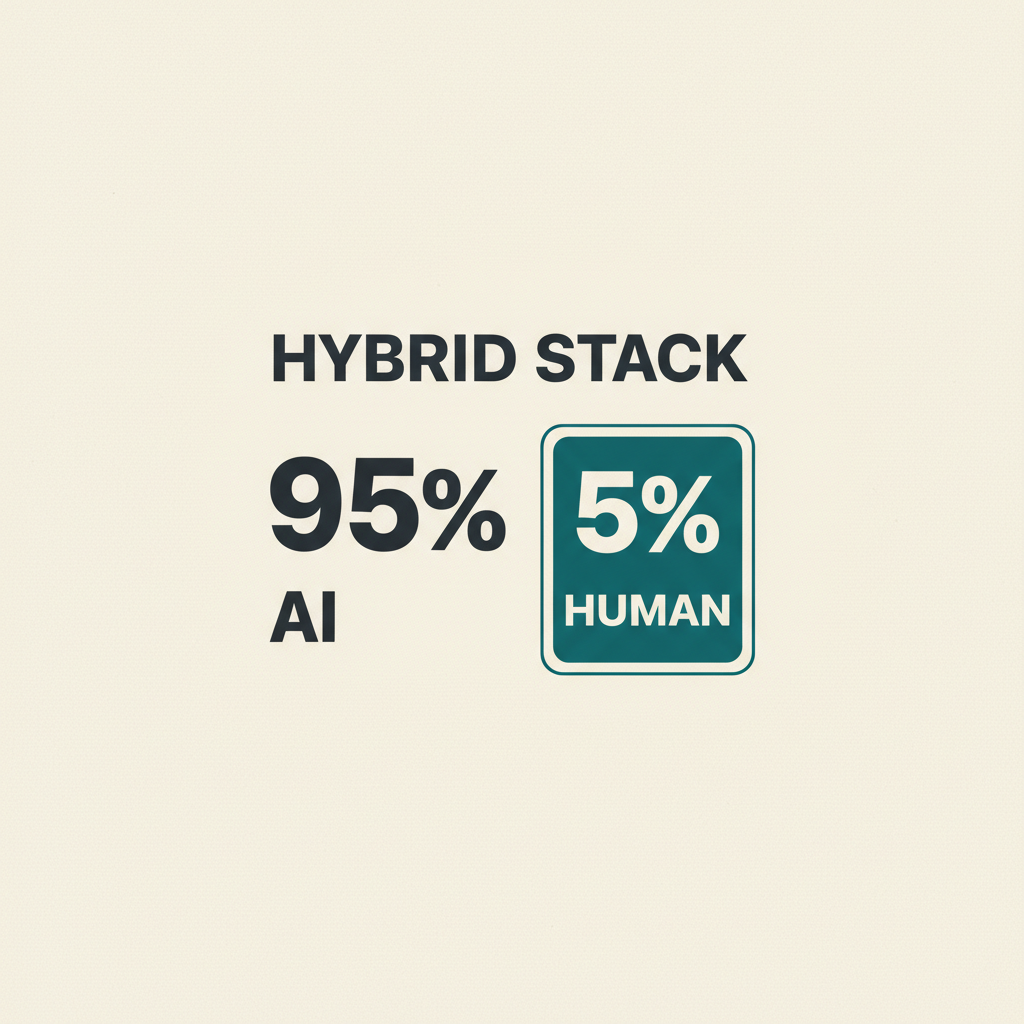
That's the frame for this article. AI voice agents handle the majority of employer verification calls better than humans do — faster, more consistent, fully recorded, lower cost-per-case. But not all calls. The 5–15% where AI struggles share recognizable patterns, and those patterns are predictable enough to design around. This piece maps which call types belong on which side of the handoff, what the handoff should look like operationally, and what to ask vendors to find out if their hybrid stack is real or just a marketing slide.
Where AI voice consistently outperforms human callers
The case for AI voice in employment verification isn't theoretical in 2026. It's operational.
Call volume and consistency are the core advantage. A human verification team has a hard ceiling — concurrent calls are bounded by headcount, and headcount is bounded by recruiting, training, and turnover. An AI platform has no such ceiling. You can take on a bigger client, absorb a volume spike, or grow loan volume without frantically staffing or getting burned when someone quits. Superunit processes verifications with an average completion time of 0.82 business days, with 80% completed within 48 hours. That's not achievable with a human-only model at any reasonable cost.
Standard mid-size employers with IVR routing are where AI executes most cleanly. When a borrower worked at a 500-person manufacturing company, the verification path is predictable: call the main line, navigate to HR, reach the employment verification extension, deliver the script, capture the response. AI handles this sequence without fatigue, without variation, and without the 15-minute hold music problem that causes human callers to abandon and reschedule. Every AI-placed call is recorded, transcribed, and timestamped automatically. The record exists whether the call completes, hits voicemail, or reaches a refusal. For FCRA-governed workflows, that documentation trail isn't a nice-to-have — it's the compliance record. Human callers require manual logging, and manual logging has gaps.
Off-hours availability matters more than it sounds. Many HR departments at small and mid-size employers have staff who check voicemail after hours and return calls the next morning. An AI agent that leaves a structured, professional voicemail at 7pm gets a callback the next morning. A human team that stops calling at 5pm misses that window entirely.
Multilingual coverage is increasingly relevant. Platforms like Superunit support verification in 30 languages. A human verification team in the U.S. typically does not.
The cost economics are straightforward: AI voice verification runs at a fraction of the cost of human-staffed outbound calling. For high-volume operations, the difference compounds quickly.
Where AI voice still struggles — and why
This section is the honest part. Every vendor will tell you their AI handles everything. Here's what actually breaks.
Small employers with no IVR and a single decision-maker
A borrower worked at a 15-person construction company. The employer's "HR department" is the owner's wife, who answers the main line, which is also the cell phone she uses for everything else. There's no IVR to navigate. The call requires someone to explain who's calling, why, what they need, and to make a real-time judgment about whether the person who answered is actually authorized to confirm employment.
AI voice agents can handle this call. What they can't always handle is the judgment layer that comes when the person who answers says, "I don't know if I should be giving that out — let me check with [owner's name]." That's not a script branch. That's a relationship moment, and relationship moments in small-employer verification sometimes require a human to close.
HR contacts who explicitly refuse to engage with AI
This is a real pattern, and it's growing. Some HR professionals — particularly at larger employers with formal verification policies — will state directly that they don't speak with automated systems and will only provide information to a human verifier or through a written channel. No amount of AI prompt engineering resolves this. The call needs to be handled by a person.
The operational question isn't whether this happens (it does), but how often. In most verification portfolios, it's a small percentage of cases — but it's concentrated in specific employer types (large healthcare systems, government agencies, certain financial institutions) where verification is already harder.
Escalations requiring real-time judgment
Consider this scenario: an HR contact at a mid-size employer picks up, confirms the candidate worked there, then adds, "I can confirm employment, but I can't confirm the salary without approval from legal — can you call back tomorrow?" That's a conditional response that requires a human to evaluate: Is this worth a callback? Is the partial confirmation sufficient for the use case? Does the underwriter need the salary figure specifically?
An AI agent can log the partial response and flag the case. What it can't do is make the judgment call about whether to accept partial information, negotiate a faster resolution, or escalate to the requesting party for guidance. That's the kind of real-time contextual judgment that human verifiers are better at.
Foreign-language and accent edge cases
AI voice platforms have gotten significantly better at handling accents and non-standard speech patterns. They haven't solved the problem entirely. When a verification call reaches an HR contact whose primary language isn't English and who speaks with a heavy accent in a regional dialect, speech recognition error rates climb. The agent may misparse a response, log incorrect data, or loop the conversation in a way that frustrates the contact into hanging up. The edge cases — a Haitian Creole-speaking HR assistant at a small employer, a recent immigrant-owned business where the call lands in a language the platform doesn't support well — still benefit from a human who can adapt.
FCRA-edge compliance scenarios
The Fair Credit Reporting Act creates specific obligations around adverse action, dispute handling, and the permissible scope of information gathering. When a verification call surfaces information that could trigger an adverse action — a discrepancy between reported and actual employment dates, a termination for cause that the candidate didn't disclose — the handling of that call enters territory that requires attorney-adjacent judgment.
An AI agent can flag the discrepancy and halt the automated workflow. What it shouldn't do is continue the conversation in a way that could create liability. These cases need to route to a human who understands the FCRA implications, or to legal review, before any output is sent to the requesting party. Similarly, verification of employment at foreign employers — particularly in GDPR-regulated jurisdictions — introduces data handling requirements that may not be fully addressable in a standard AI voice workflow.
The "I'll call you back" loop
This one is mostly a non-issue when the platform handles callbacks well — AI agents can answer inbound calls at any hour, reconstruct case context, and complete the verification without human involvement. Where it does become a problem is timing. If an employer promises to call back and then actually does it two weeks later, after the case has already been closed or the compliance window has expired (10 days for most mortgage VOE workflows), there's no clean way for the AI to re-engage. The case is done. A human may need to reopen it, contact the requesting party, and determine whether a late callback is still usable. That's an edge case, but it's a real one in high-stakes lending workflows where the verification window is tight.
The handoff is the product: how hybrid stacks work in production
The most important design principle in a hybrid verification stack is this: the handoff is the product. A system where AI handles 90% and humans handle 10% is only as good as the quality of the transition between them.
Here's what a well-designed handoff looks like in production:
AI attempts first. The AI agent places the call, navigates the IVR, delivers the script, and captures the response. If the call completes cleanly, the case closes automatically with a full transcript and timestamp.
Escalation triggers fire automatically. When the AI detects a defined escalation condition — three failed attempts, an explicit AI refusal, a conditional response, a flagged compliance scenario — the case routes to the human queue without manual intervention.
The human receives full context. This is where most hybrid stacks fail. The human verifier who picks up the escalated case needs to see: the call transcript from every AI attempt, the flagged escalation reason, the employer contact information, the case details, and any partial information the AI captured. If the human has to start from scratch, the hybrid stack is just a sequential two-system process, not an integrated workflow.
The audit trail spans both layers. The compliance record for a case that started with AI and ended with a human should be a single, unified document — not two separate logs that a compliance officer has to manually reconcile. This matters for FCRA chain-of-custody documentation and for any regulatory review of the verification process.
The human completes and posts back. Once the human verifier completes the call, the result posts back into the same case management system, with the same structured output format as an AI-completed case. The requesting party — the lender, the CRA, the background screening company — shouldn't need to know which layer handled the call.
Platforms like Truework and HRLogics Clear Verify handle portions of this workflow for specific use cases. Superunit is designed around the full hybrid stack — AI voice, email, and fax as the default layer, with human verification specialists as the exception path, and a unified audit trail across both.
Designing escalation triggers for your ops team
The quality of a hybrid stack depends almost entirely on how well the escalation triggers are defined. Vague triggers ("route to human when AI can't complete") produce vague results. Specific triggers produce a queue that human verifiers can work efficiently.
Here's a practical starting set. Adjust thresholds based on your SLA requirements and case mix.
☐ No contact after exhausting the standard attempt sequence. AI can place far more attempts per day than any human team — that's not the issue. The issue is when all attempts fail to reach a live person or voicemail despite correct contact information. At that point, the problem is usually bad contact data, not call volume. A human reviewing and refreshing the employer's contact information is more useful than more automated dials to a dead number.
☐ HR contact explicitly refuses to speak with an automated system. Any call where the contact uses language like "I don't talk to automated systems," "I need to speak with a person," or "call me back with a human" should route immediately. Don't attempt a fourth AI call.
☐ Captured data confidence below threshold. If the AI's ASR confidence score on the response falls below a defined threshold (typically 85–90% for structured data fields like employment dates), flag for human review rather than logging potentially incorrect data.
☐ Conditional or partial information captured. If the employer provides partial confirmation ("I can confirm employment but not salary") or conditional confirmation ("subject to legal review"), route to human to evaluate whether the partial response is sufficient or a follow-up is required.
☐ Case flagged by underwriter or compliance as high-touch. Some cases arrive pre-flagged — a discrepancy on the application, a borrower with a complex employment history, a compliance officer who has noted the file requires extra documentation. These should bypass the standard AI queue and go directly to human.
☐ Foreign employer with GDPR or other data-handling restrictions. Verification of employment at employers in GDPR-regulated jurisdictions, or in countries with specific data transfer restrictions, should route to a human who can assess the appropriate handling before the call is placed.
☐ Callback received after the case has been closed or the compliance window has expired. A callback that arrives the next morning is fine — the AI handles it. The trigger for human review is a callback that arrives after the case has already been closed or after the applicable verification window has passed (typically 10 days for mortgage VOE). At that point, a human needs to assess whether the late response is still usable and whether the requesting party needs to be notified.
Questions to ask vendors that surface AI/human handoff quality
Most vendors will tell you they have a hybrid model. These questions will tell you if they actually do.
☐ "How do you define escalation triggers, and are they configurable?" A vendor with a real hybrid stack can tell you exactly what conditions route a case to human. If the answer is vague ("we have a team that handles exceptions"), the handoff isn't systematic.
☐ "What context does the human verifier receive when they pick up an escalated case?" The answer should include: full AI call transcripts, attempt log with timestamps, flagged escalation reason, and any partial data captured. If the human starts with a blank case, the handoff is broken.
☐ "Does your audit trail span both the AI and human layers in a single document?" This is the compliance question. For FCRA chain-of-custody purposes, a unified audit record is required. Two separate logs that require manual reconciliation create compliance exposure.
☐ "Do you provide the human verification team, or do I bring my own?" Some platforms are AI-only and expect you to staff the human exception path. Others include human verifiers as part of the service. Know which model you're buying before you sign.
☐ "What's your current human escalation rate, and how has it trended over the past 12 months?" A vendor who knows this number has a real hybrid operation. A vendor who doesn't know it is probably not tracking it.
☐ "How do you handle employer callbacks that come in after hours or to a different contact number than the one the AI used?" Callback continuity is one of the most common failure points in hybrid stacks. The answer should describe a specific technical and operational workflow, not a general reassurance.
Frequently Asked Questions
Can AI voice agents handle all employment verification calls?
No — and any vendor who claims otherwise is overselling. AI voice agents handle the majority of verification calls well: standard employers with IVR routing, consistent script execution, and HR contacts who are accustomed to automated verification requests. The cases where AI consistently underperforms are small-employer calls requiring real-time judgment, HR contacts who explicitly refuse to engage with AI, and FCRA-edge compliance scenarios that require attorney-adjacent care. A well-designed hybrid stack routes these cases to human verifiers automatically, rather than letting them stall in an AI queue.
What percentage of verification calls still need a human?
In most production deployments, 5–15% of cases require human intervention at some point in the workflow. The exact percentage depends on the case mix: a portfolio heavy in small-employer or self-employed borrowers will see a higher escalation rate than one concentrated in mid-size corporate employers. The goal isn't to minimize the human percentage at all costs — it's to make sure the right cases are escalating for the right reasons, and that humans are working the cases where their judgment adds real value.
What happens when an HR contact refuses to talk to an AI agent?
This should trigger an immediate escalation to the human queue. The AI agent should log the refusal, note the contact's stated preference, and route the case to a human verifier with that context intact. The human verifier then places the call, identifies themselves, and completes the verification through the standard verbal process. The key operational requirement is that this transition happens without the human verifier having to reconstruct the case from scratch — they need the prior call transcript and the flagged reason for escalation in front of them before they dial.
How do AI verification platforms hand off to humans?
In a well-designed hybrid stack, the handoff is automated and context-rich. When an escalation trigger fires — failed attempts, a refusal, a compliance flag, a conditional response — the case routes automatically to a human queue with the full AI call transcript, attempt log, and flagged reason attached. The human verifier completes the call, logs the result in the same case management system, and the output posts back in the same structured format as an AI-completed case. The audit trail spans both layers. In less mature implementations, the handoff is manual and lossy — a human gets a case number and has to pull context from multiple systems. That's the version to avoid.
Should I buy an AI verification agent or hire more human verifiers?
For most verification operations in 2026, the answer is: buy the AI platform and design a smaller, more skilled human team for the exception path. The economics are clear — AI verification runs at a fraction of the cost of human-staffed outbound calling, and the throughput advantage is significant. But "AI-only" is a deployment mistake. The right model is AI as the default for 85–95% of cases, human verification specialists for the remainder, and a handoff protocol that makes the transition invisible to the requesting party. The human team in this model isn't doing the same work as before — they're handling the cases that genuinely require judgment, which tends to be more interesting work than high-volume script execution.
What to do next
If you're evaluating AI voice platforms for employment verification, the best AI voice agents for employment verification calls (2026) breaks down the leading platforms by use case, compliance coverage, and handoff capability.
If you want to understand how the AI pipeline works end-to-end — from contact research through call placement to result submission — Inside an AI Verification Agent: From 'Call HR' to 'Submit Result' walks through the full workflow.
Superunit is built for the hybrid model described in this article: AI voice, email, and fax as the default layer, human verification specialists as the exception path, and a unified audit trail that spans both. Book a demo to see how it works on your case mix.